Articles

What is Nostro and Vostro Account

Nostro and Vostro accounts are two types of bank accounts used in international banking transactions. These terms originate from Latin, with Nostro meaning “our” and Vostro meaning “your”. In this article, we will discuss the meaning and differences between these two types of bank accounts.

What is a Nostro account?

A Nostro account is a bank account that a bank holds in a foreign currency in another bank. These accounts are maintained by banks to facilitate their foreign currency transactions. Nostro accounts are used by banks to hold funds that belong to their customers in other countries. These accounts are denominated in the currency of the foreign country where the account is held. Banks use Nostro accounts to receive and make payments in foreign currencies.

For example, if Bank A in the United States has a customer who wants to make a payment to a supplier in Japan, Bank A would use its Nostro account in Japan to make the payment in Japanese yen. The funds would be transferred from the customer’s account in Bank A to Bank A’s Nostro account in Japan, and then Bank A would use these funds to make the payment to the supplier in Japan.

What is a Vostro account?

A Vostro account is a bank account that is held by a foreign bank in the local currency of the country where the account is held. Vostro accounts are maintained by banks to facilitate transactions with their international customers. These accounts are used by banks to hold funds that belong to their customers in the local currency of the country where the account is held. Banks use Vostro accounts to receive and make payments in local currencies.

For example, if Bank A in the United States has a customer who wants to receive a payment from a supplier in Japan, Bank A would give its Japanese partner bank permission to open a Vostro account with Bank A. The supplier in Japan would transfer the payment in Japanese yen to Bank A’s Vostro account in Japan. Bank A would then credit the payment to its customer’s account in the United States in US dollars.

Differences between Nostro and Vostro accounts

The main difference between Nostro and Vostro accounts is that Nostro accounts are held by a bank in a foreign country, denominated in the currency of the foreign country, and used to facilitate its transactions in that country. On the other hand, Vostro accounts are held by a foreign bank in the local currency of the country where the account is held, used to facilitate transactions with the bank’s international customers.

Another difference between Nostro and Vostro accounts is the ownership of the account. A Nostro account is owned by the bank that holds the account, while a Vostro account is owned by the foreign bank that opened the account.

A Nostro Account of one country can be a Vostro Account for another country, and vice versa

ELECTRONIC GOLD RECEIPTS (ECRs) – UNION BUDGET 2023-24

SEBI has been notified as the regulator of gold exchanges in the country. SEBI has come up with the ‘Framework for operationalizing the Gold Exchange in India’ vide Circular dated January 10, 2022 and has also declared the instrument for trading in Gold Exchange ,i.e., EGRs as ‘securities’ under Section 2(h)(iia) of the Securities Contracts (Regulation) Act 1956 dated December 24, 2021 vide Gazette notification. The SEBI Regulations, 2021’ provides that any person willing to carry on the business of providing vaulting services in relation to gold, i.e., storage and safekeeping of physical gold deposited by the depositor for the purpose of trading in EGRs may apply to SEBI and obtain registration to act as a Vault Manager. The Framework provides that stock exchanges willing to trade in EGRs may apply to SEBI and begin trading in EGRs in new segment. A structure of the transactions in respect of creation, trading and conversion of EGR into Physical Gold has also been defined.

PROPOSED AMENDMENTS

In line with these new developments, it is proposed to bring following amendments in the ITA to make the conversion of physical gold into EGR and vice versa tax neutral:

  • New provision, S. 47(viid), is proposed where under the conversion of physical gold (held as capital asset) into EGRs issued by a Vault Manager and vice versa, shall not be considered as ‘transfer’ within the meaning of S. 47 of the ITA. Hence, there would be no capital gain arising at the time of mere conversion.
  • Further, S. 2(42A) is proposed to be amended to include the period of holding of the converting asset in the period of holding of the converted asset. In other words, the period of holding of EGRs would include even the period for which the physical gold was held by the assessee prior to conversion into EGRs and vice versa. (Clause (hi) to Explanation 1 of S. 2(42A)).
  • Lastly, it is proposed that the Cost of Acquisition of EGRs shall be deemed to be the cost of gold in the hands of the person in whose name EGRs is issued. Similarly, where gold is released against an EGRs, the COA of the gold shall be deemed to be the cost of the EGRs in the hands of such person. (S. 49(10)).

These amendments will become effective from April 1, 2024 and shall accordingly, apply in relation to the AY 2024-25 and subsequent AYs.

CLARIFICATION REQUIRED

There is an ambiguity in relation to the indexation benefit. A clarification is also needed with regard to the classification of Electronic Gold Receipts (ECRs) as Short term or Long term, whether EGRs must be considered as a Capital Asset (36months/ 3 years) or as a Security (12 months/1 year).

AMENDMENT IN BUYBACK RULES

The Securities and Exchange Board of India (SEBI) on Tuesday, 20th December,2022 amended the buyback rules to gradually phase out the Open Market Route in favor of the Tender Route. SEBI has improvised the present share buyback norms for listed companies and has tightened the disclosure rules to increase the transparency and credibility of the market.

Over a period, buyback regulations have also evolved with the growth and complexity of the market. Initially, buyback was allowed only from the open market through stock exchanges. Subsequently, the tender method for buyback was also introduced. It was felt that the stock exchange route is less efficient as it may be difficult to buyback through this route the full quantity without affecting the share price. Also, it may take a long time to complete it. Further, there is a possibility of one shareholder’s entire trade getting matched with the purchase order placed by the company, thus depriving other shareholders to avail the benefit of the buyback. Therefore, a time-bound program under the tender route was considered a superior method.

Few of the major changes made by SEBI are:

Increase in the limit of utilization of proceeds:

The regulator has amended the rules on the way of using of the funds which are kept for buyback. The buyback norms at present require companies to utilize at least 50 per cent of the amount earmarked for this purpose. On Tuesday, SEBI has raised the minimum threshold of 50 per cent to 75 per cent for the purpose of utilization. In case of failure to use the minimum proceeds by the company, SEBI can direct the merchant banker to forfeit the amount deposited in an Escrow account.  

Reduction in time for the process of buyback:

In buyback under the Tender route, SEBI has reduced the timeline for completion by 18 days. It has dropped the requirement to file the draft letter of offer.

Advertisement for buyback to increase awareness/knowledge:

SEBI has made it mandatory to place the relevant advertisements/ documents with respect to buyback, such as, copy of the public announcement, letter of offer etc. on the respective website of the stock exchange(s), merchant banker and the company for better dissemination of information to shareholders.

Revision of price for Buyback:

SEBI has permitted the upward revision of the buyback price until one working day prior to the record date.

Additional Points:

  • SEBI has also decided to create a separate window on stock exchanges for undertaking buyback till the time tender offers are fully in effect.
  • SEBI has proposed to reduce the timeline for completion of process of buyback to 66 days with effect from 1st April, 2023 and to 22 working days from 1st April, 2024.
  • It has also been proposed that Open Market Route will be completely closed by 1st April, 2025.

These amendments aim to streamline the process of buyback, create a level-playing field for investors and promote the ease of doing business. We hope that the new regime to choose tender route for buyback with a shorter timeline and ability to revise the price upwards until the late stage will make the buy-back scheme much more robust, market friendly as well as investor friendly.

BUSINESS TRUSTS- REITs & InvITs (Tax Implication)

WHAT IS A BUSINESS TRUST?

Section 2(13A) of Income Tax Act defines Business Trust as below: “Business trust” means a trust registered as, —

 (i)  an Infrastructure Investment Trust under the Securities and Exchange Board of India (Infrastructure Investment Trusts) Regulations, 2014 made under the Securities and Exchange Board of India Act, 1992 (15 of 1992); or

 (ii)  a Real Estate Investment Trust under the Securities and Exchange Board of India (Real Estate Investment Trusts) Regulations, 2014 made under the Securities and Exchange Board of India Act, 1992 (15 of 1992)

Business Trust act like a mutual fund that invest into real estate projects or infrastructure projects by raising resources from different investors. These trusts can raise capital by way of issue of units which are listed on a recognized stock exchange. Business trusts can also raise debt from people – both residents and non-residents. It is not necessary that the business trust must be listed, however it is mandatory for it to be registered with SEBI with effect from 1st April, 2020.

REAL ESTATE INVESTMENT TRUST (REITs)

REITs are companies which owns, manages and finance few income-generating real estate and offers its units to public investors. REITs own many types of commercial real estate, ranging from office and apartment buildings to warehouses, hospitals, shopping centers, hotels and even timberlands.

Globally, REITs invest primarily in completed, revenue generating real estate assets and distribute major part of the earning among their investors. Typically, most of such investments are in completed properties which provide regular income to the investors from the rentals received from such properties.

REITs are principally expected to invest in completed assets. Income would consist of rental income, interest income or capital gains arising from sale of real assets / shares of SPV. They are managed by professional managers which usually have diverse skill bases in property development, redevelopment, acquisitions, leasing and management etc. Listed REITs provide liquidity and therefore provide easy exit to the investors.

INFRASTRUCTURE INVESTMENT TRUSTS (InvITs)

Infrastructure Investment Trusts make direct investment in infrastructure facilities which are yielding income e.g., Toll Road, Railways, Inland waterways, Airport, Urban public transport. InvITs will allow infrastructure developers to monetize specific assets, helping them use proceeds for completing projects of theirs stalled for want of funds.

Structure of InvITs is quite similar to REITs. The main difference is InvITs make investment into infrastructure facilities whereas REITs make investment in commercial real estate properties.

TAXABILITY UNDER SECTION 115 UA:

  1. IN THE HANDS OF THE UNIT HOLDERS:

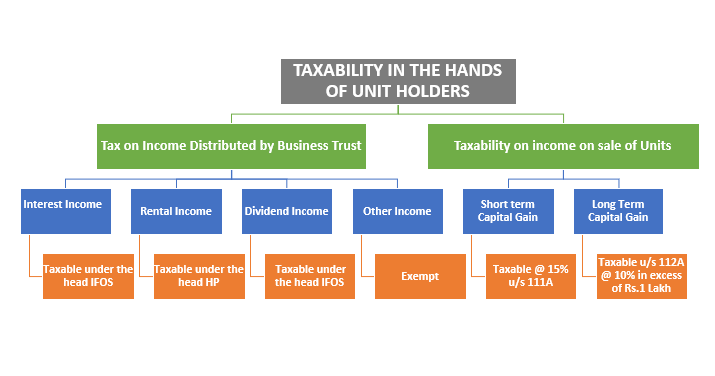
The income of unit holders of Business Trust can be categorized into two parts.

Tax on Income Distributed by Business Trust:

There is a special taxation regime for taxability of income distributed by such business trusts in the hands of the unit holders. The income distributed by a business trust to its unit holders shall be deemed to be of the same nature and in the same proportion in the hands of the unit holders, as it had been received by, or accrued to the business trust. The person distributing the income on behalf of the business trust is required to furnish the statement of income distributed to the unitholder in Form No. 64B by the 30th June. Example Mr. Saurabh, a resident individual, has received the following ‘Form 64B – Statement of income distributed by a business trust to the unit holders’ for the Financial Year 2017-18.

S. No.Amount DistributedDate of DistributionAmount of income in the nature of interest referred to in Section 10 (23FC)Amount of Income in the nature of renting or leasing referred to in Section 10(23FCA)Amount of Income in the nature of Dividend Amount of Other Income
150,00025/10/202030,000  20,000
275,00016/11/2020 25,00027,00023,000

Let’s see how taxability of each of such income will be determined in the hands of Mr. Saurabh

  • Income in the nature of Interest: The income in the nature of interest referred to in sub clause (a) of Section 10(23FC) is chargeable to tax in the hands of the unit holders. If the unit holder is non-resident the rate of tax on such income is 5% and for resident unit holders, it is chargeable to tax at slab rates. This income is exempt in the hands of the business trust. This interest received or receivable from a special purpose vehicle by the business trust is accorded a pass-through treatment and is taxable directly in the hands of the unit holders. The business trust is liable to deduct TDS on this interest income at the rate of 10% in the case of a resident unit holder and 5% in the case of Non-resident unit holders. Example Mr. Saurabh has to include the income of Rs.30,000 distributed by the business trust on 25/10/2017 as an interest income in his Income Tax Return.
  • Rental Income: The rental income referred to in Section 10(23FCA) is taxable income in the hands of the unit holders. Any income of a business trust, being a real estate investment trust, by way of renting or leasing or letting out any real estate asset owned directly by such business trust is exempt in the hands of the business trust. This income is chargeable to tax in the hands of the unit holders as rental income. The REIT is liable to deduct TDS on such distributed income at the rate of 10% for resident unit holders and at the rates in force for non-resident unit holders. Example Mr. Saurabh has to show the income of Rs.25,000 distributed on 16/11/2017 by the business trust as rental income in his Income Tax Return.
  • Dividend Income: Earlier, the dividend component of the income distributed by the business trust is exempt in the hands of the unit holder. The business trust was also provided an exemption in respect of such income. However, with effect from April 1, 2020, there has been an overhaul of India’s dividend tax regime. Until now Indian companies were required to pay DDT and shareholders (except non-corporate residents) were exempt. Going forward, the tax incidence will shift from the company to the shareholders.
  • Any Other Income: Any distributed income, referred to in section 115UA, received by a unit holder from the business trust is exempt in the hands of the unit holder as per Section 10(23FD). Example The income of Rs.20,000 received on 25/10/2017 and Rs.23,000 received on 16/11/2017 is exempt in the hands of Mr. Saurabh.

Tax on Income on Sale of Units

The profit from the sale of the units of the business trust is chargeable to tax under the head capital gains. The tax treatment will differ for the Short-term capital gains and long-term Capital gains. The period of holding of units of the business trust to qualify as a long-term capital asset is more than 36 months.

  • Short-Term Capital Gain: The short-term capital gains on which STT is paid is chargeable to tax at the rate of 15% as per section 111A. The deductions under Chapter VI-A are not allowed from such capital gains.
  • Long-Term Capital Gain: The long-term capital gains on which STT is paid were exempt in the hands of the Unit holders under Section 10(38) till the A.Y 2018-19. Exemption for long-term capital gains arising from the transfer of units of business trust has been withdrawn by the Finance Act, 2018 with effect from Assessment Year 2019-20 and a new section 112A is introduced in the Income-tax Act. As per Section 112A, long-term capital gains arising from the transfer of a unit of a business trust shall be taxed at 10% (without giving the benefit of indexation). The tax on capital gains shall be levied in excess of Rs.1 lakh. The deductions under Chapter VI-A are not allowed from such capital gains.

2. IN THE HANDS OF THE BUSINESS TRUST: 

REITs have been conferred as hybrid pass-through status for income tax purposes, meaning that the onward distribution of income by a REIT to its unit holders retains the same character as the underlying income stream received by the REIT. Interest income and rental income from property held directly by the trust, is not taxable in the hands of the REIT. However, any capital gains on the sale of assets/ shares of an SPV are taxable in the hands of the trust, depending on the period of holding whereas dividend income is not liable to tax. Further, any other income earned by a REIT shall be subject to tax at the maximum marginal rate. Business trust is compulsorily required to file return as per section 139(4E)

STATEMENT UNDER SUB-SECTION (4) OF SECTION 115UA:

(1) The statement of income distributed by a business trust to its unit holder shall be furnished to the Principal Commissioner or the Commissioner of Income-tax within whose jurisdiction the principal office of the business trust is situated, by the 30th November of the financial year following the previous year during which such income is distributed;

Provided that the statement of income distributed shall also be furnished to the unit holder by the 30th June of the financial year following the previous year during which the income is distributed.

(2) The statement of income distributed shall be furnished under sub-section (4) of section 115UA by the business trust to –

  • the Principal Commissioner or the Commissioner of Income tax referred to in sub-rule (1), in Form No. 64A, duly verified by an accountant in the manner indicated therein and shall be furnished electronically under digital signature;
  • the unit holder in Form No. 64B, duly verified by the person distributing the income on behalf of the business trust in the manner indicated therein.

FORM 64A

This form will comprise of the statement of income paid or credited by a venture capital company under section 115U of the Income Tax Act 1961. Any individual who is responsible of making payment of the income distributed on behalf of a business trust to a unit holder is required to furnish a statement to the authority within the prescribed time. This form can be submitted at the post offices and banks designated for this purpose. Form 64A can be found online on the official Income Tax filing website and can be downloaded from Forms download section or Directly download Form 64A. The form contains several details which need to be filled out before submission. It is important to fill out the correct details before submitting the form. Copy of certificate of registration under SEBI, copy of trust deed registered under the provisions of the registration act, 1908, Audited accounts including balance sheet, annual report and certifies copies of income shall be enclosed with the form 64A at the time of submission.

FORM 64B

The person distributing the income on behalf of the business trust is required to furnish the statement of income distributed to the unitholder in Form No. 64B by the 30th June.

CAPITAL GAIN TAX EXEMPTION UNDER SECTION 54 OF IT ACT, 1961

SECTION 54 OF INCOME TAX ACT, 1961

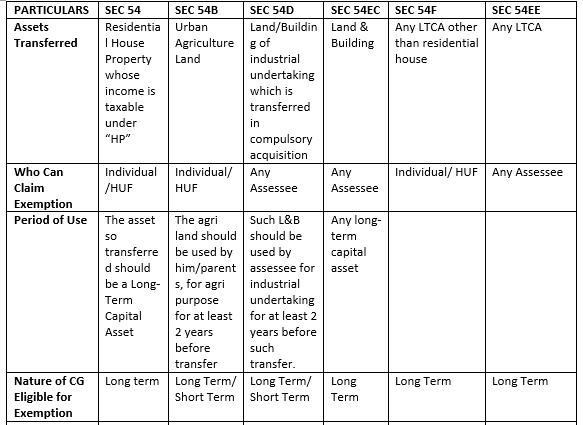
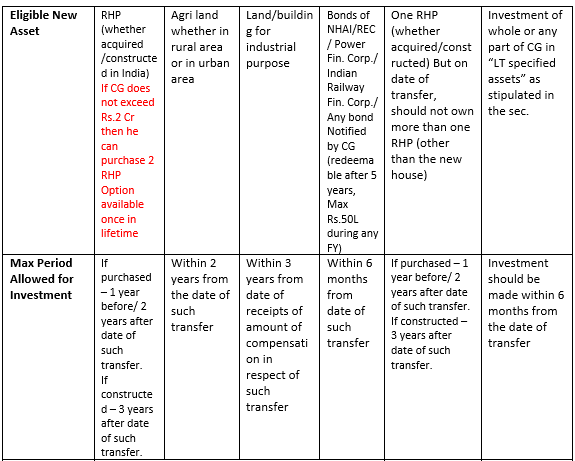
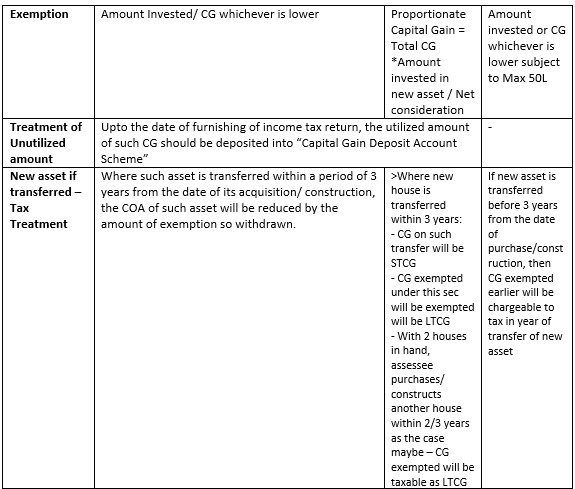
Section 54 gives exemption to a taxpayer who sells his residential house and acquires another residential house property from the sale proceeds. Only an Individual/HUF can avail this benefit under this section.

Section 54 provides the exemption which will be the lower of the following:

  • Amount of capital gains arising on transfer of residential house;
  • Amount invested in purchase/construction of new residential house property including the amount deposited under Capital Gains Deposit Account Scheme.

Exemption is available in respect of only one residential house property purchased/constructed in India. If more than one house is purchased or constructed, then exemption can only be claimed for one house property under this section. No exemption is available in respect of house purchased outside India.

In order to control any misutilization of the exemption claimed under section 54, this section restricts the taxpayer to sell the new house property till 3 years. If the taxpayer sells the new house before 3 years the benefit received under this section will be withdrawn and the amount of capital gain which was earlier claimed as exempt, will be deducted from the cost of acquisition of the new house at the time of computation.

SECTION 54EC OF INCOME TAX ACT, 1961

Section 54EC provides exemption to any assessee for the capital gain arising on sale of land or building, if when the amount received on sale is invested in Specified Bonds. Specified Bonds refer to those bonds issued by the Rural Electrification Corporation, National Highway Authority of India, Power Finance Corporation Limited, Indian Railway Finance Corporation or bonds issued by the Central Government if specified, which are redeemable after 5 years and are issued on or after 01.04.2018.

The Capital gain arising should be invested in a long term specified Asset within 6 months from the date of transfer.

The exemption shall be the lower of:

  • Actual Capital Gain; or
  • Amount invested in Specified Bonds (less than Rs.50 Lakhs)

However, the maximum investment that can be made under this section is Rs.50 Lakhs
In case bonds are transferred or converted or availed loan or advance against these bonds before the expiry of 5 years, the Capital Gain exempted earlier shall be taxed as LTCG in the year of violation of the condition.

SECTION 54B OF INCOME TAX ACT, 1961

Section 54B provides the benefit of exemption to those Individuals/HUFs who wishes to sell their agricultural land and acquire another agricultural land from the sale proceeds. The old agricultural land acquired shall be used by him or his parents for at least 2 years before the transfer and the maximum period for the new investment to be made in agricultural land is 2 years from the date of such transfer.

Exemption under section 54B shall be lower of:

  • Amount of capital gain arising on transfer of agricultural land; or
  • Investment in new agricultural land including the amount deposited under Capital Gain Account Scheme.

The exemption shall be withdrawn if the new agricultural land is sold before the period of 3 years from the date of acquisition, and therefore the amount, earlier exempt, will be reduced from the cost of acquisition of agricultural land.

SECTION 54D OF INCOME TAX ACT, 1961

Section 54D gives the benefit to claim exemption to any assessee where capital gain arises on compulsory acquisition of land or building forming a part of industrial undertaking and reinvesting the amount for acquiring new land or building for the purpose of shifting or re-establishing the industrial undertaking.

Exemption under this section is available for both short term and long-term capital gain.

It is mandatory that the transferred asset should have been used for the industrial purpose for a period of at least two years before the date of acquisition. The transferor is required to invest the amount in purchasing any other land or building for the purpose of shifting or re-establishing the industrial units. The said amount needs to be invested within a period of three years from the date of receipt of the compensation

The exemption under section 54D would be lower of:

  • Capital Gain on compulsory acquisition of land or building; or
  • Amount of investment for acquisition of new land or building

The exemption would be retracted if the new land or building acquired is transferred before 3 years from the date of acquisition and hence, capital gain exempted under this section would be reduced from the cost of acquisition at the time of computation of capital gain.

SECTION 54F OF INCOME TAX ACT, 1961

Section 54F provides the exemption to an Individual/HUF on sale of any long-term capital asset (other than residential house property) and the proceeds shall be reinvested for purchasing or constructing a residential house property. Maximum period for investing in new residential property by purchase is one year before or two years after the date of transfer and by construction is 3 years from the date of transfer.

Exemption under this section shall be available as:

  • Full amount of capital gain is exempt in case full consideration is invested.
  • Although in case proportionate consideration is invested, exemption will be as

Exemption = Long term capital gain * Amount re-invested / Net consideration

Here, Net consideration refers to the value of consideration excluding any expenditure incurred exclusively for the purpose of transfer.

Exemption would be withdrawn if the taxpayer sells the residential property, whether purchased or constructed, before 3 years from the date of transfer. Exemption under Section 54F will not be available in certain cases:

  • If the taxpayer already owns more than one residential house property at the date of transfer of the asset
  • If the taxpayer purchases additional residential house (other than the new house purchased/constructed for exemption under Section 54F) within a time frame of one year from the date of transfer.
  • If the taxpayer constructs additional residential house (other than the new house constructed/purchased for exemption under Section 54F) within a time frame of three years from the date of such transfer.

SECTION 54EE OF INCOME TAX ACT, 1961

Exemption under section 54EE is available only when the assessee has earned capital gain on the sale of long-term capital gain and reinvested the sale proceeds either partly or in whole in “long term specified assets”. Long Term Specified Assets refers to the unit of funds issued on or after 1st April, 2019 as notified by the Government.

The investment must be made withing 6 months from the date of transfer of such specified asset. And, the total investment in such assets cannot exceed the limit of Rs.50 lakhs during the financial year and even in the subsequent financial year.

Exemption under section 54EE shall be lower of:

  • Amount of capital gain arising on the transfer; or
  • Rs.50 lakhs.

The amount so invested in the new specified asset cannot be transferred or converted within a period of 3 years. However, if the taxpayer transfer or converts the asset before the lock in period of 3 years, the exemption would be withdrawn and he/she would have to pay long-term capital gain on such transfer.

CAPITAL GAIN DEPOSIT ACCOUNT SCHEME:

To claim exemption under section 54 or under any other subsections as mentioned above, the taxpayer shall accept the conditions according to each section. If the capital gain arising on transfer of the asset is not utilized till the date of filing the return of income, then the benefit of exemption can be availed by depositing the unutilized amount in Capital Gains Deposit Account Scheme in any branch of public sector bank, in accordance with Capital Gains Deposit Accounts Scheme, 1988 (hereafter referred as Capital Gains Account Scheme). The new asset can be acquired by withdrawing the amount from the said account within the specified time-limit as the case may be.

NON UTILIZATION OF AMOUNT DEPOSITED IN CAPITAL GAIN DEPOSIT ACCOUNT SCHEME:

 In case the amount deposited under the Capital Gains Account Scheme is not utilized within the specified period for acquisition of the asset, then the unutilized amount (for which exemption is claimed) will be taxed as long- term capital gain of the year in which the specified period gets over.

KNOW ABOUT ADVANCE TAX!

WHAT IS ADVANCE TAX?

Advance tax means income tax should be paid in advance instead of lump sum payment at year end. It is also known as pay as you earn tax. These payments have to be made in instalments as per due dates provided by the income tax department.

Total estimation is used for the calculation of advance tax.

WHO SHOULD PAY ADVANCE TAX?

  • If the total tax liability exceeds Rs 10,000 in a financial year in case of salaried, freelancers and businesses, then advance tax shall be payable.
  • Senior citizens whose income does not come out of any business or profession, are exempt from paying advance tax.
  • In case of Presumptive income under Section 44AD for Businesses & for Professionals, the taxpayers have to pay the whole amount of their advance tax in one instalment on or before 15th March of any financial year. Although, they can pay all of their tax dues till 31st March.

ADVANCE TAX DUE DATES

Advance Tax has to be paid in different installments.  The due dates for payment of advance tax are as follows:

STATUSBy 15th
June
By 15th SeptemberBy 15th DecemberBy 15th March
All assessee (other than eligible assessee as referred to in section 44AD/44ADA)  Minimum 15% of Advance Tax  Minimum 45% of Advance Tax  Minimum 75% of Advance Tax  100% of Advance Tax
Taxpayers who opted for presumptive taxation scheme of section 44AD/44ADA  Nil  Nil  Nil  100 % of Advance Tax

INTEREST UNDER SECTION 234B

Interest under section 234B is applicable in two of the following cases:

  1. When the tax liability after reducing TDS for the financial year is more than Rs.10,000 and advance tax hasn’t been paid, or
  2. The advance tax is paid, but the amount paid is less than 90% of the ‘assessed tax’.
  • Interest is calculated @ 1% on (Assessed Tax less Advance Tax).
  • Part of a month is rounded off to a full month.
  • The amount on which interest is calculated is also rounded off in such a way that any fraction of a hundred is ignored.

Example

Assume that Saurabh needs to pay a total tax of Rs.1,00,000. And, TDS of Rs 85,650 has already been deducted from his income. Saurabh paid Rs.5,000 on 25th March and he paid the balance amount at the time of filing his return on 17th July. Let’s check whether Saurabh needs to pay interest under section 234B.

  • First let’s calculate assessed tax.
  • Assessed tax = Rs 1,00,000 (total tax) – Rs 85,650 (TDS) = Rs 14,350
  • Saurabh should have paid at least 90% of the assessed tax or 90% of Rs 14,350 which is Rs 12,915 before 31st March. However, he paid only Rs 5,000.
  • Therefore, Saurabh is liable to pay interest under section 234B.
  • Rs 14,350(Assessed Tax) – Rs 5000(Advance Tax) = Rs 9350.
  • Interest will be calculated as : Rs 9350 x 1% x 4 months (April, May, June, July) = Rs 374
  • Rs 374 is the interest payable under section 234B by Saurabh.

INTEREST UNDER SECTION 234C

Income Tax Department strives to make it as easy and convenient for citizens to comply with advance tax payments. So, one has the option of paying it in 4 instalments quarter-wise over the financial year.

However, if there is still any default, there are consequences in the form of interest penalty. Section 234C deals with the interest to be levied on the defaulters of payment of Advance Tax installment.

The interest for late payment is set at 1% on the amount of tax due. It is calculated from the individual cut-off dates shown above, till the date of actual payment of outstanding taxes.

The interest under this section is charged according to the scheduled installments. The taxpayer has to pay interest if he/she has paid the advance tax

  • Less than 12% of assessed tax before 15th June
  • Less than 36% of assessed tax before 15th September
  • Less than 75% of assessed tax before 15th December
  • Less than 100% of assessed tax before 15th March/31st March

Example

Mr. X has the total tax liability of Rs.1,00,000. This tax is to be paid in 4 installments. The calculation of interest to be charged for delay will be calculated as follows:

Due DatesAdvance Tax to be paidAdvance Tax actually paidShortfallMonths for which interest is chargedPenal Interest
15th June15,000 (15%)5,00010,000310000*1%*3= 300
15th Sept45,000 (45%)25,00020,000320,000*1%*3 = 600
15th Dec75,000 (75%)35,00040,000340,000*1%*3 = 1200
15th March1,00,000 (100%)50,00050,000150,000*1%*1= 5000

CRITERIA UNDER WHICH ADVANCE TAX INTEREST IS NOT PAYABLE

In case, there is any shortfall in the payment of advance tax due if it is on account of underestimation or failure to estimate the amount of capital gains or speculative income (lottery income, gambling income, etc), then the interest would not be payable.

Also, interest would not be payable if the taxpayers pay his dues before the end of the financial year.

FAQs

Q1. Does an NRI have to pay advance tax?

  • An NRI, who has an income accruing in India and the tax liability is in excess of Rs 10,000, is liable for payment of advance tax.

Q2. A senior citizen only has interest and pension income. Should he/she pay advance tax?

  • Resident senior citizens who do not have income arising out of business or profession, are not liable for advance tax.

Q3. Can an assessee claim deduction under 80C while estimating income for determining my advance tax?

  • Yes. An assessee can consider all the deductions under 80C (whichever applicable within the limit) while estimating the income for the financial year for computing your advance tax liability.
Q4. How can we make payment for advance tax?

  • Advance tax payment can be made using Challan 280 just like any other regular tax payment.

Q5. What happens if an assessee misses the deadline for payment of the last installment of advance tax, i.e., on 15th March?

  • Payment of advance tax can be made on or before 31st March of the year. Such payment will still be treated as advance tax only.

E-INVOICING UNDER GST

APPLICABILITY

E-invoicing has been made compulsory by the Government of India for the taxpayers whose annual turnover is above Rs.10 crores with effect from 1st October, 2022 vide Notification No.17/2022. The taxpayers must comply with the provisions of e-invoicing in F.Y. 2022-23 and onwards if their aggregate turnover exceeds the specified limit in any of the financial years from 2017-18 to 2021-22. E-invoicing is applicable only for the B2B invoices.

PROCESS FOR REGISTRATION UNDER E-INVOICING

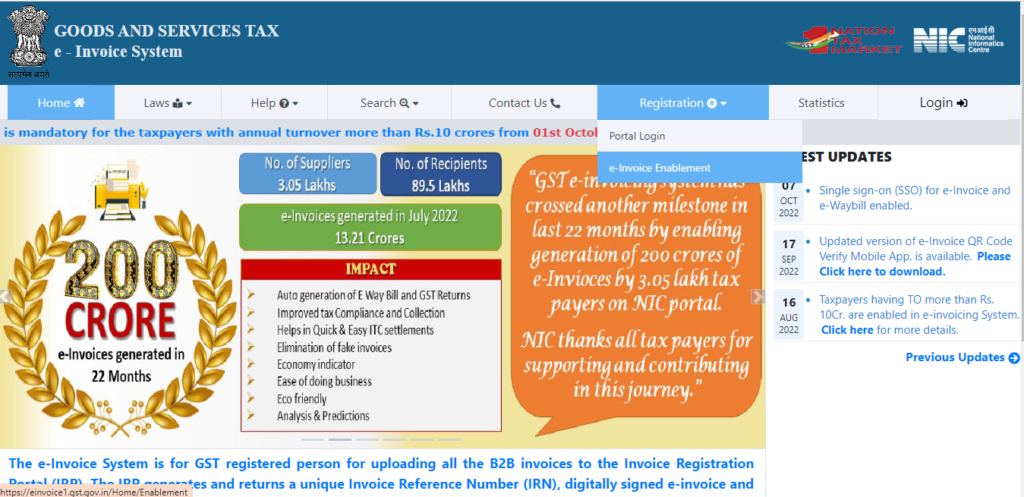
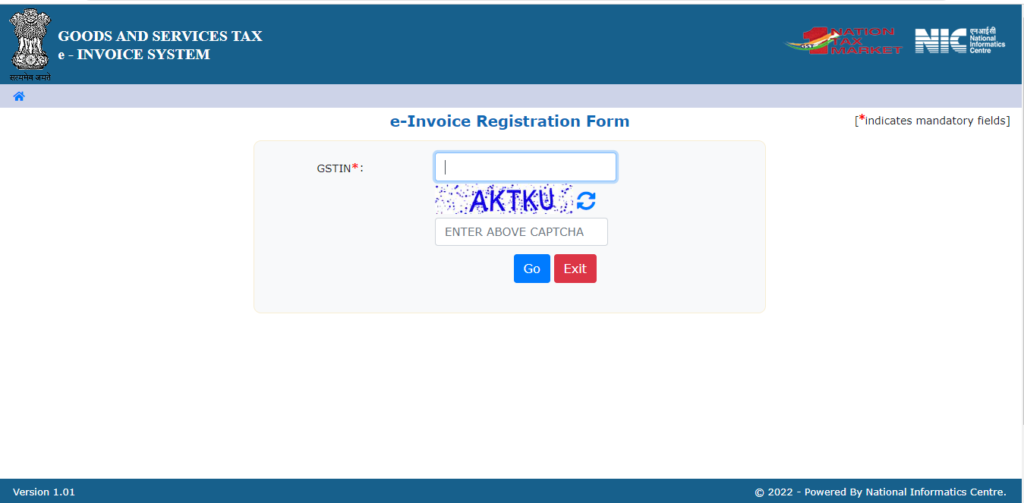
Step 1: Go to the website https://einvoice1.gst.gov.in/

Step 1: Go to the website https://einvoice1.gst.gov.in/.

Step 2: Click on “e-invoice enablement” under ‘Registration’ tab.

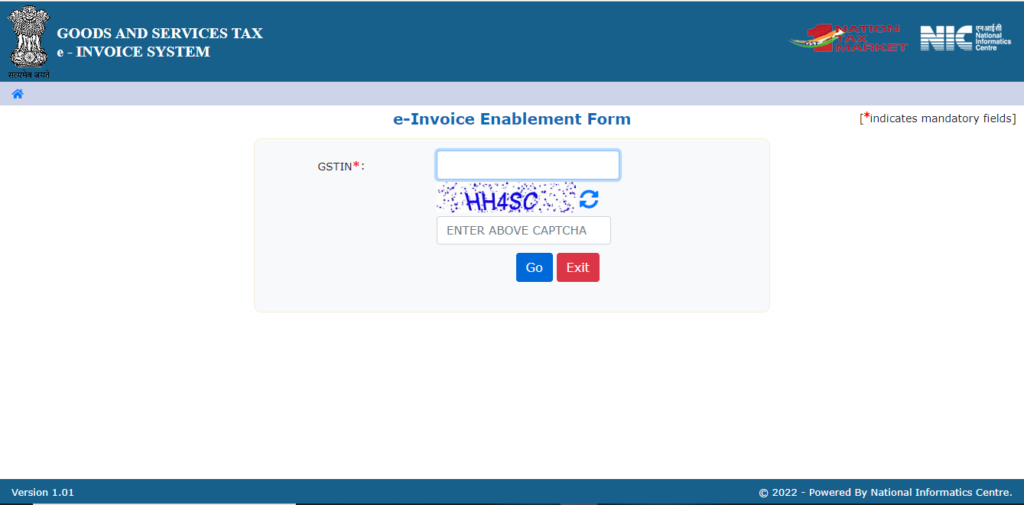
Step 3: Under the enablement form, provide the GST number, enter the captcha, and click on “GO”.

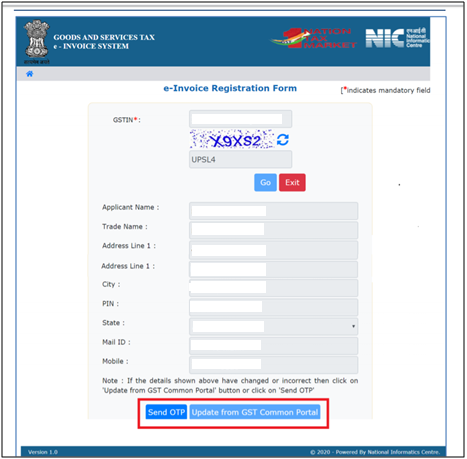
Step 4: Details regarding the Name, Mobile Number, Email Address, etc will appear automatically using the GSTIN. Click on “send OTP” and verify it by providing the OTP sent to the mobile number.

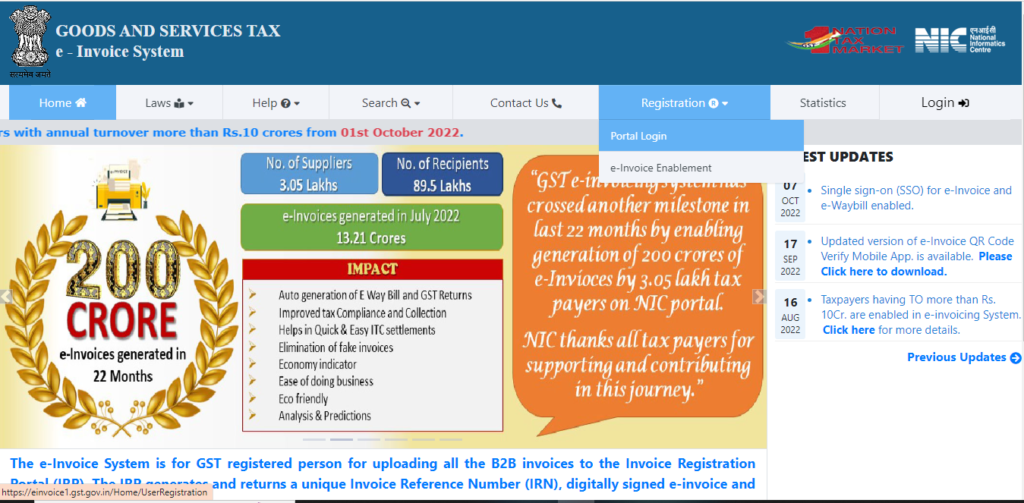
Step 5: After filling out the e-invoice enablement form, go to “e-portal login” under the registration tab.

Step 6: A similar box will appear asking for the GSTIN.

Step 7: After providing the GSTIN and entering the captcha, the following details would be shown.

Step 8: If all the details are not correct, you can click on “Update from GST Portal”, and the details would appear as in the GST Portal. Click on “Send OTP” when all the details are correct. OTP will be sent on the mobile number of the registered party. Verify the same.
Step 9: After verifying the same, the system asks you to set up the log in ID and Password. And after that, you can log in to the e-invoice portal by using the same credentials.

Step 10: As soon as we log in, a dialog box will appear asking for the details (like name, email id, address, designation) of the authorized person.

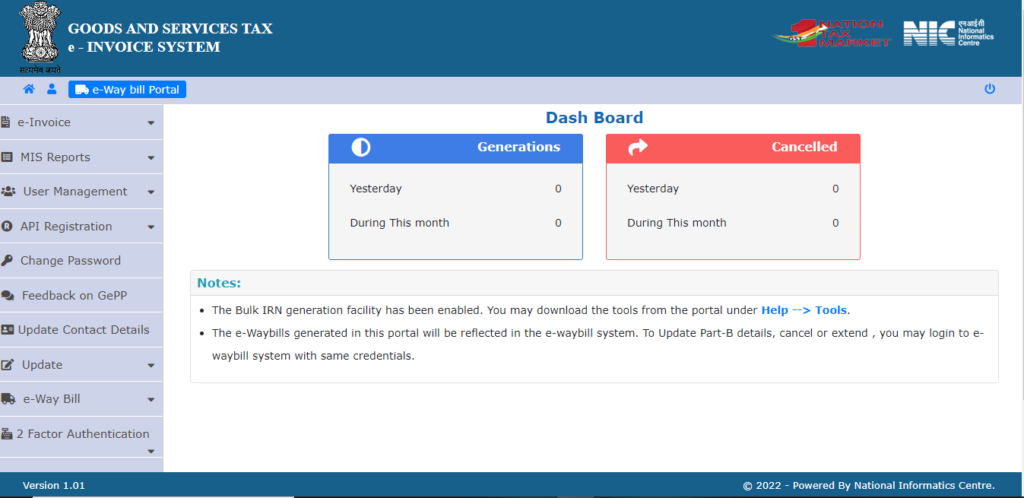
Step 11: Fill in the details and you are ready. Your registration process is complete, and the screen shown below shall appear after logging in. You can create e-invoices and e-way bills here.
HOW TO GENERATE AN E-INVOICE

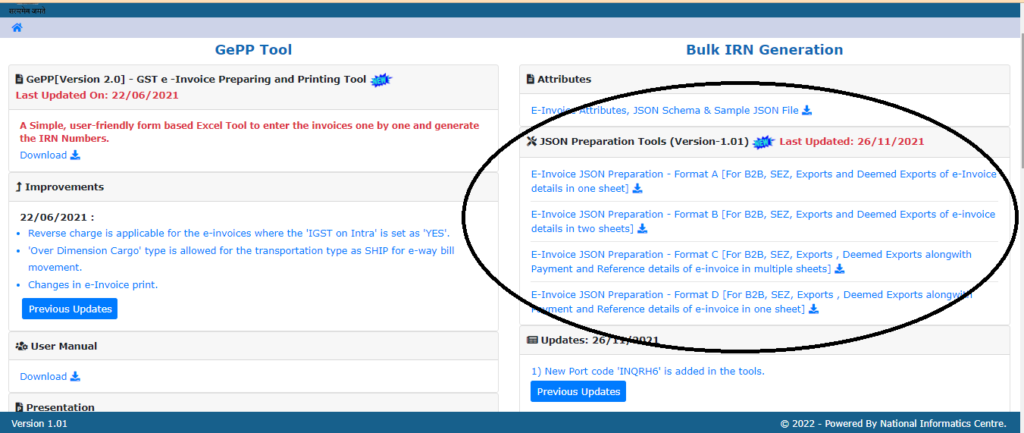
Step 1: On the Home page, Go to Help<Tools<Bulk Generation Tools.

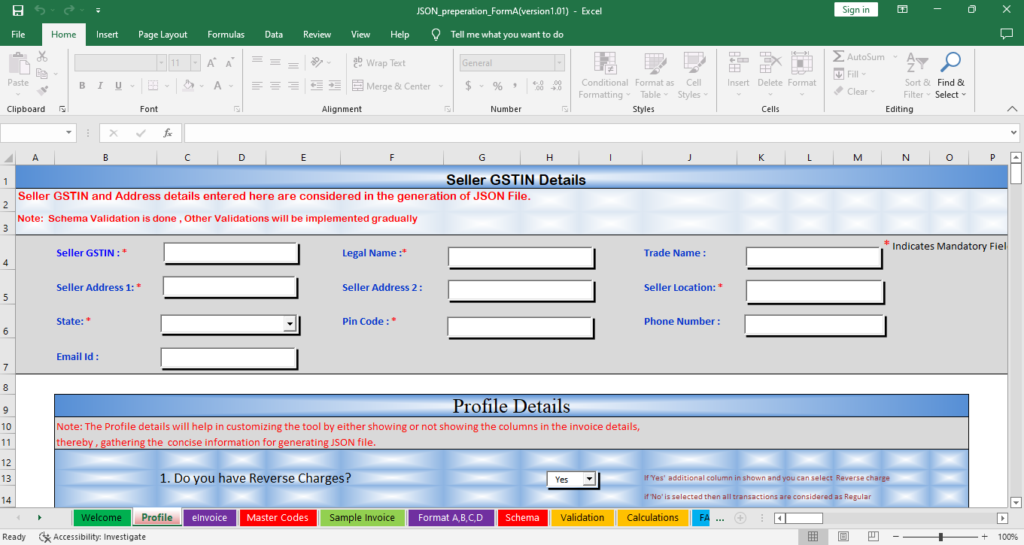
E-Invoice JSON Preparation Utility Template can be seen on the site like above. Format (A,B,C,D) can be chosen according to your requirements.

Step 2: The template would be downloaded in Excel Format. Fill in the required details in the Profile tab and the einvoice tab.

In case the file does not open and shows an error for doubtful source, select the file<right click and go to properties<you will get an option to “Unblock” the source under the Security section.

Step 3: After filling all the details in the template, click on “Validate” and then “Prepare JSON”.

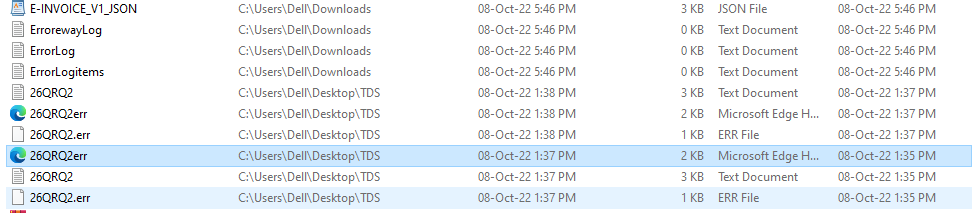
Step 4: In case any error occurs, the file will be created as below.

An html file will be created<Open the file using Google to view the error<Make the correction as required<“Validate and Prepare JSON” file again.

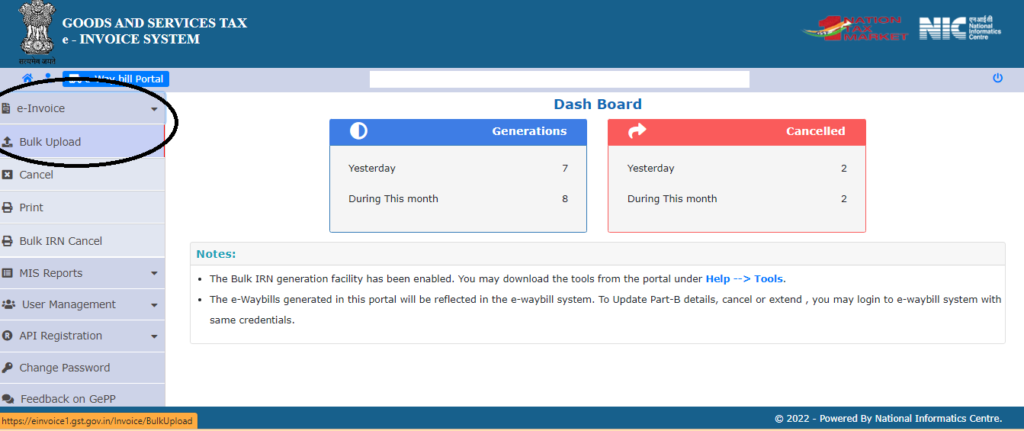
Step 5: Upload the Template file on the einvoice1 portal.

Step 6: Browse the JSON File and upload here. You can view and download the e-invoice thereafter. E-invoice will be downloaded in the format of “zip” file. Unzip the file and E-invoice will be generated in the pdf format.


FAQs

Q1. What is the time limit to generate E-invoice?

Ans. No time limit has been prescribed for the authentication of E-Invoice. However, according to the Rule 48(5), any supplier on whom e-invoicing is applicable, shall issue e-invoice every time. Normal invoice shall not be issued.

Q2. Does the E-invoice need to be signed again?

Ans. According to the proviso to Rule 46 of the CGST Rules, 2017 along with the provisions of Information Technology Act 2000, in case of electronic invoice, a supplier will not be required to sign or digitally sign the invoice.

Q3. Can an e-invoice be modified or cancelled?

Ans. E-invoice cannot be corrected or modified once uploaded. However, the option is provided to cancel the invoice and generate a new e-invoice.

Q4. What is Invoice Reference Number (IRN)?

Ans. IRN is a registration number provided by the government. It is a unique number generated by GSTN which proves the authenticity of the e-invoice after being uploaded.

Q5. Is E-Invoicing applicable for supplies having Reverse Charge?

Ans. Yes, e-invoicing is applicable for the supplies under reverse charge if the turnover exceeds the specified limit.

Q6. Does SEZ Developers also issue e-invoice?

Ans. Yes, even SEZ Developers have to issue e-invoices if the turnover exceeds the specified limit. But SEZ Units are exempt from issuing e-invoices under Notification (Central Tax) 61/2020.

HOW TO GET TDS CHALLANS THROUGH NSDL

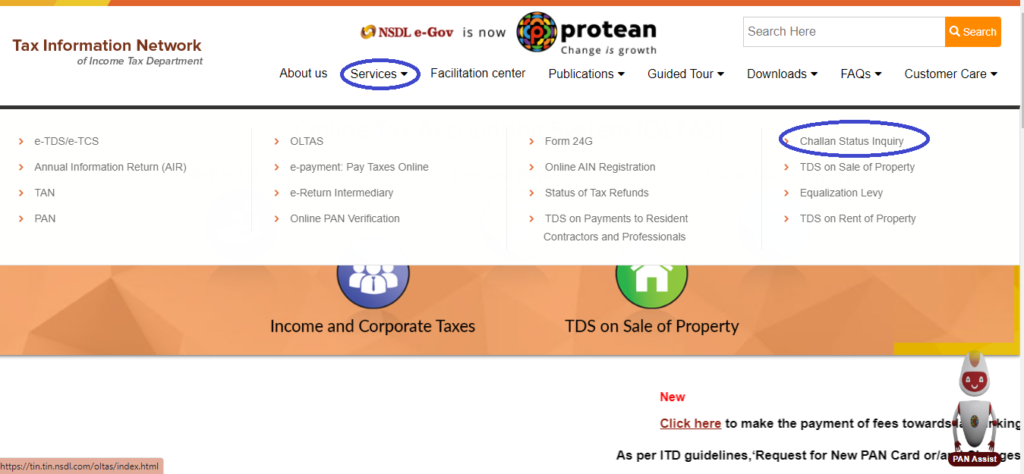
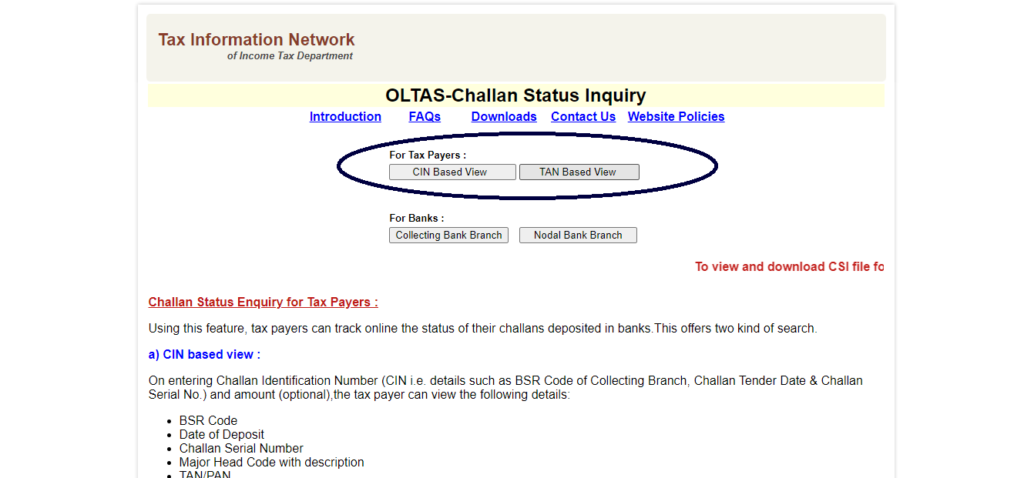
Step 1: Go to the website https://www.protean-tinpan.com/

Step 2: Click on “Challan Status Inquiry” under the ‘Services‘ tab.

Step 3: We can view the challans either by providing the CIN number or the TAN number.

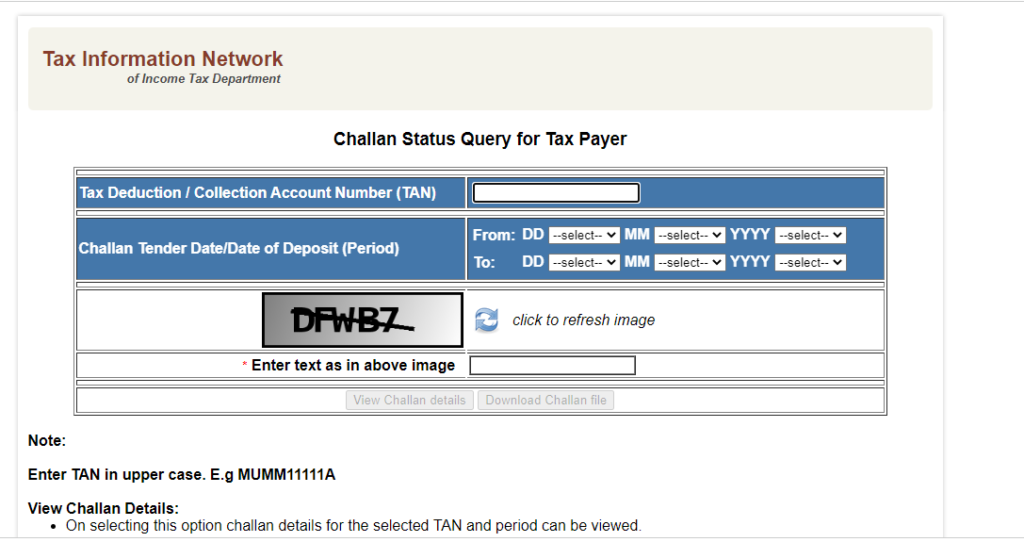
Step 4: In case of Tan Based View, fill in the details by entering the TAN number of the assessee and select the period for which you want to view the challans. Period selected should be within 24 months.

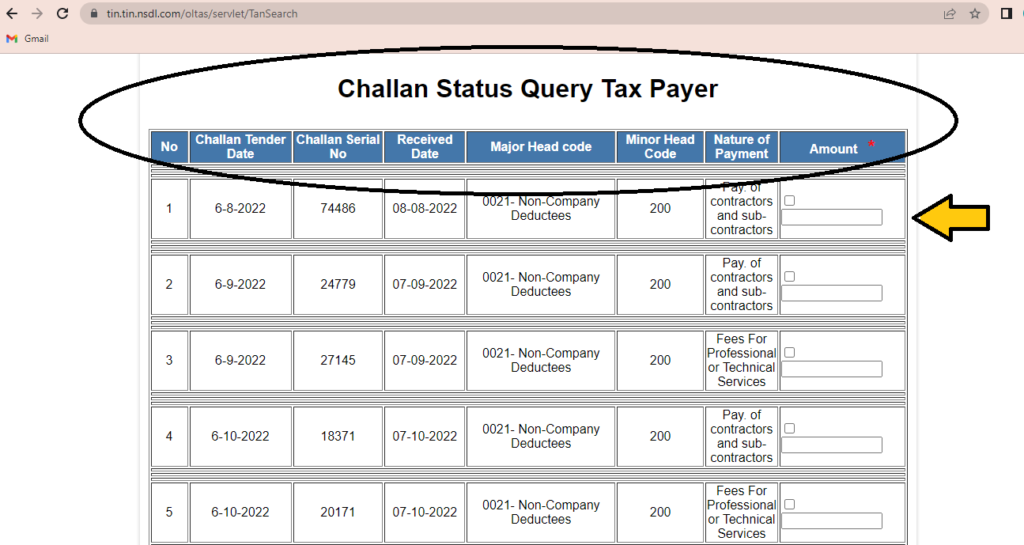
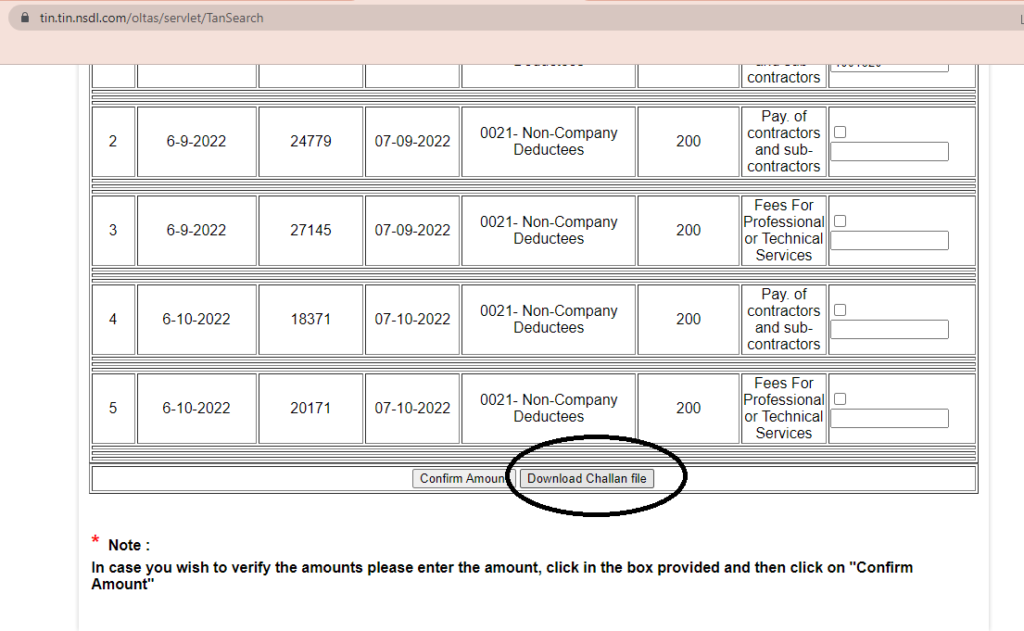
Step 5: We can view the challan details for the mentioned period as below.

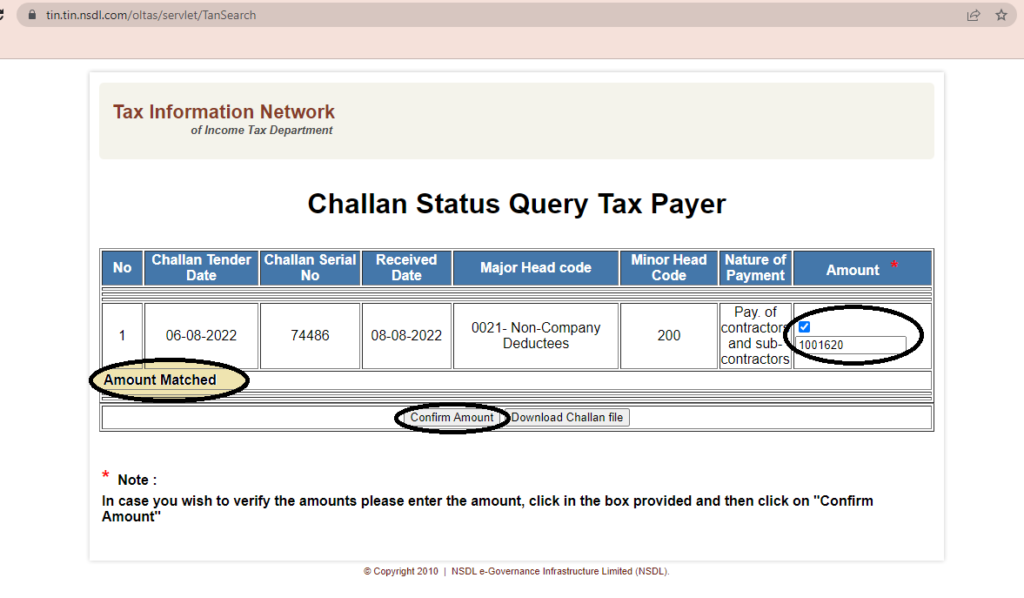
Under the given picture, the column for “Amount” has been given blank. we can enter the amount and ‘Confirm the Amount’. If the amount you have entered is correct, a text in bold would display as “Amount Matched” and vice versa.

In case you want download the challan file, click on “Download Challan File“.

A ‘csi’ file would be created, you can use that csi file for verifying the challan details while filing TDS returns.

HOW TO APPLY IN AN IPO THROUGH VARIOUS BANKS

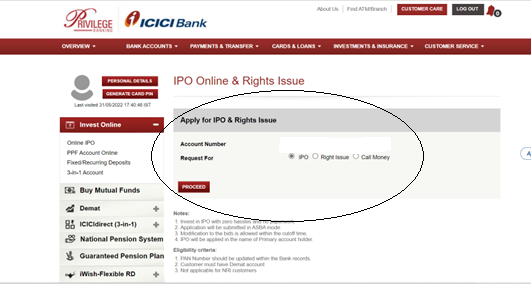
PROCESS FOR APPLYING IN AN IPO THROUGH ICICI BANK

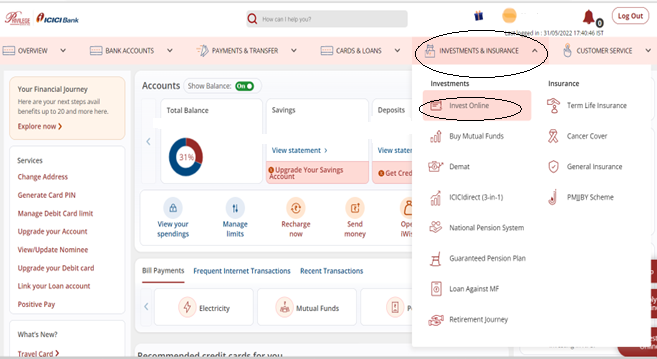
Step 1: Login to your Net Banking Account.

Step 2: Click on ‘Invest Online’ under the Investments & Insurance tab.

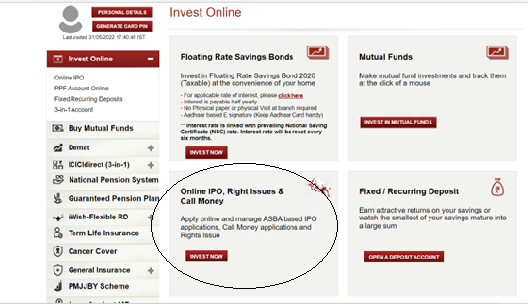
Step 3: Click on ‘Invest Now’ in the Online IPO, Right Issues & Call Money column.

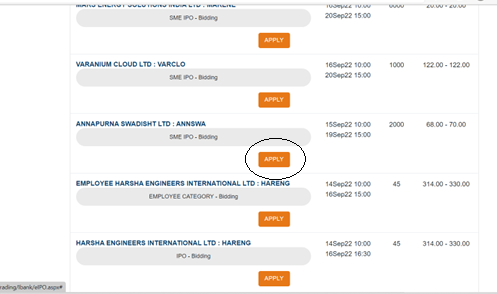
Step 4: You would get all the open IPOs for application. Click on ‘Apply’ button to choose the IPO.

Step 5: Fill in the bank details as required and proceed for the further application.

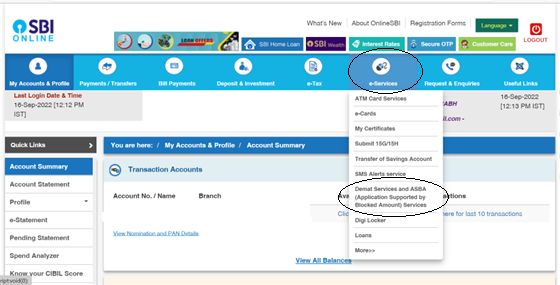
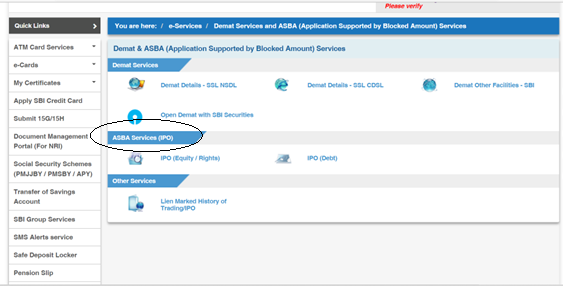
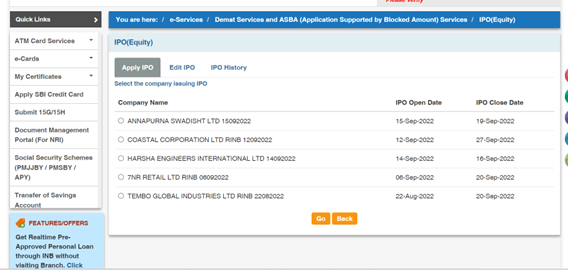
PROCESS FOR APPLYING IN AN IPO THROUGH SBI BANK

Step 1: Login to the Net Banking of SBI through the login credentials along with generating High Security Password sent on the respective mobile number.
Step 2: Click on ‘Demat Services and ASBA’ tab under “e-Services”.

Step 3: Under ASBA Services, click on “IPO”.

Step 4: List of available IPOs will appear. You can select any IPO as per your choice.

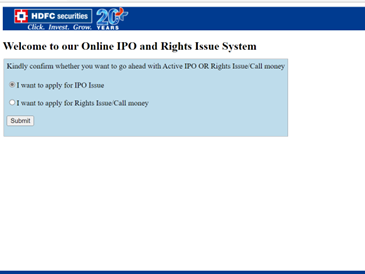
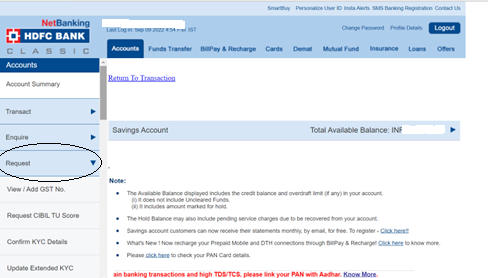
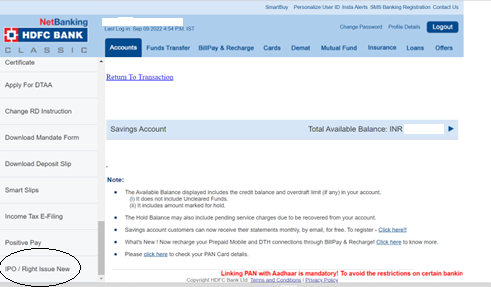
PROCESS FOR APPLYING IN AN IPO THROUGH HDFC BANK

Step 1: Login to HDFC Net Banking and click on ‘Request’ Tab on the left side.

Step 2: Select ‘IPO/Right Issue New’ under Request tab.

Step 3: Select the option for IPO Issue and choose the IPO you wish to apply for.

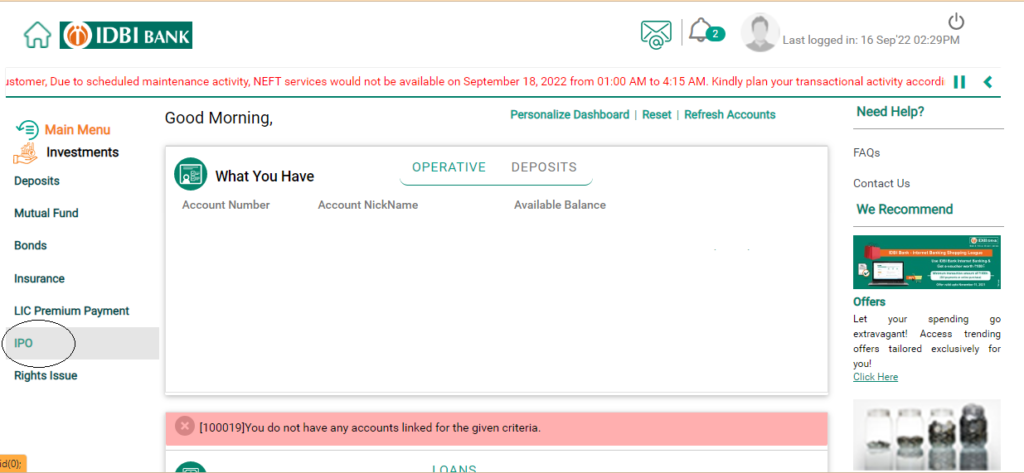
PROCESS FOR APPLYING IN AN IPO THROUGH IDBI BANK

Step 1: Login to Net Banking of IDBI Bank.

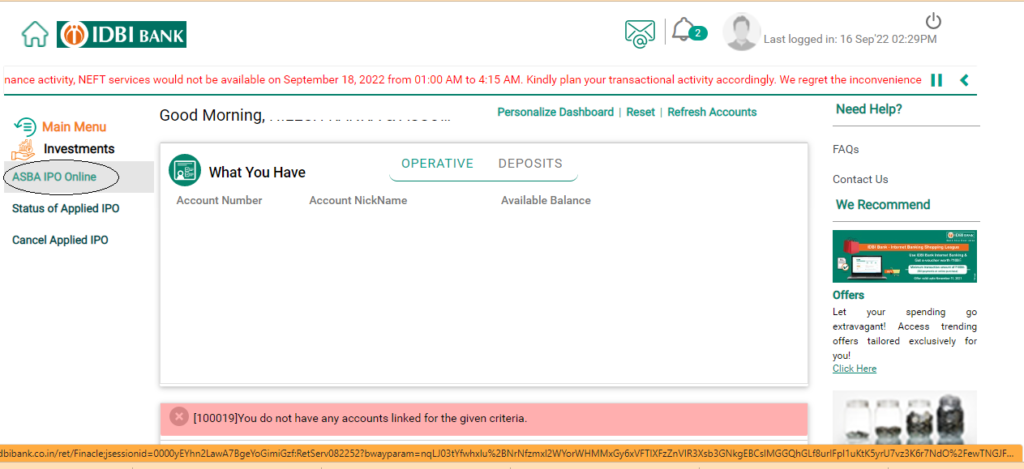
Step 2: Click on “IPO” on the left side under the Investments tab.

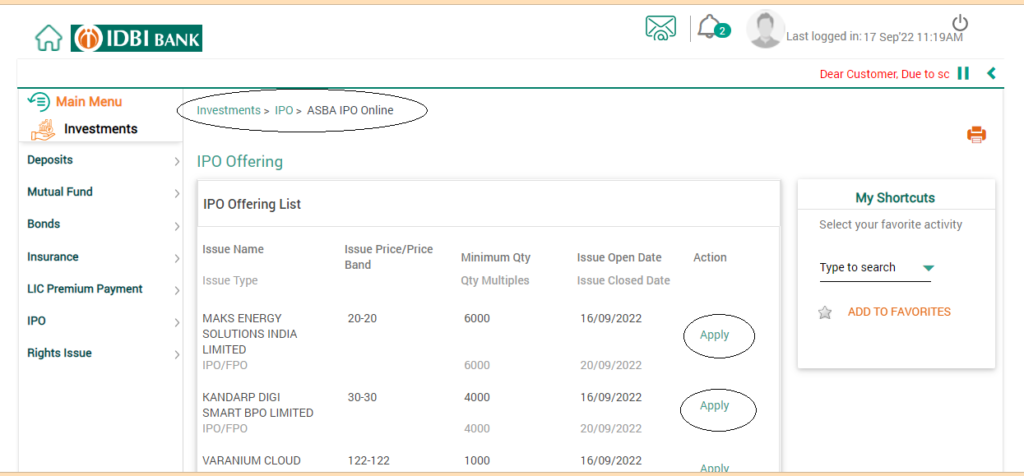
Step 3: Now, click on “ASBA IPO Online”.

Step 4: You will find the list of IPOs which are open on that date. Select the IPO of your choice and fill out the application providing the details of the quantity and amount that you want to invest.

PROCESS FOR APPLYING IN AN IPO THROUGH AXIS BANK

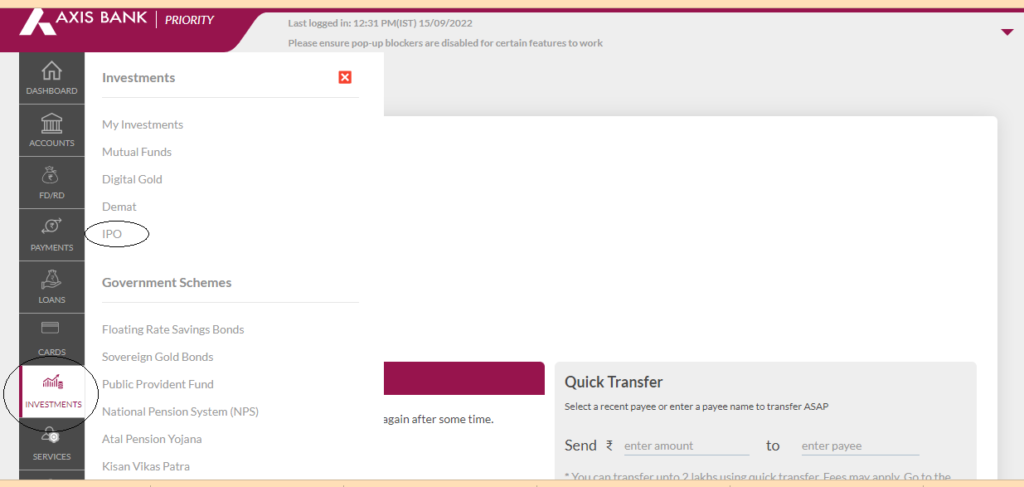
Step 1: Login to Net Banking of Axis Bank. Go to Investments>IPO.

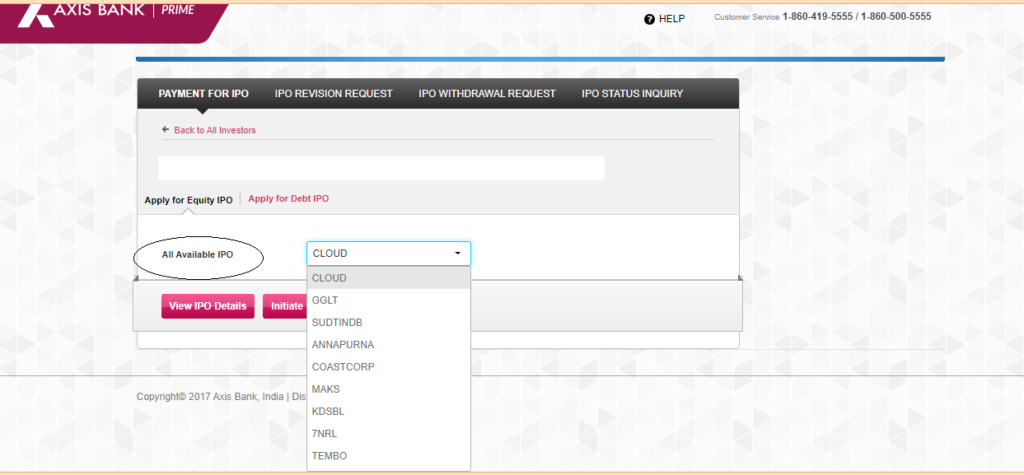
Step 2: Go to “Apply for Equity IPO” and you will get all the available options for the IPO. Choose any IPO according to your choice and fill the required details as requested in the application form.

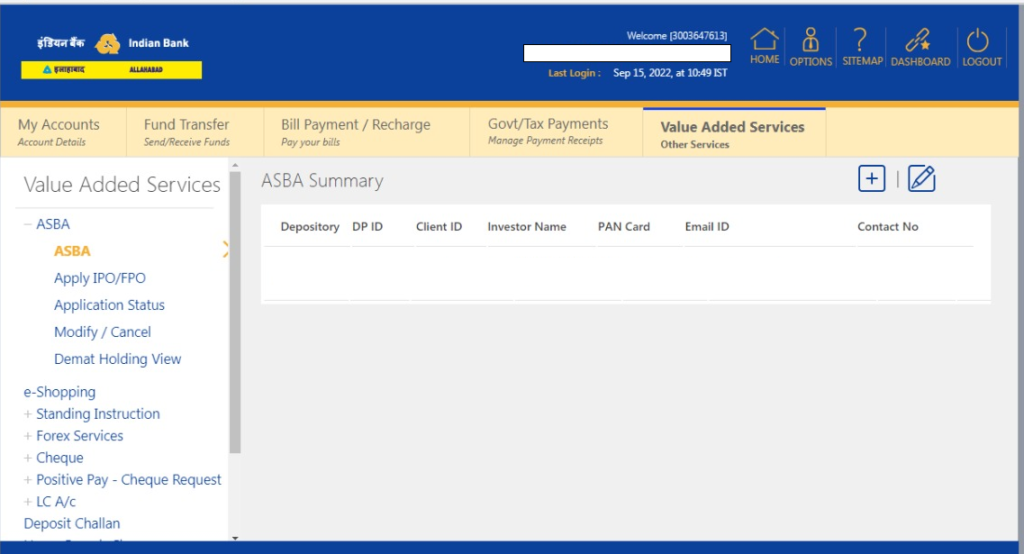
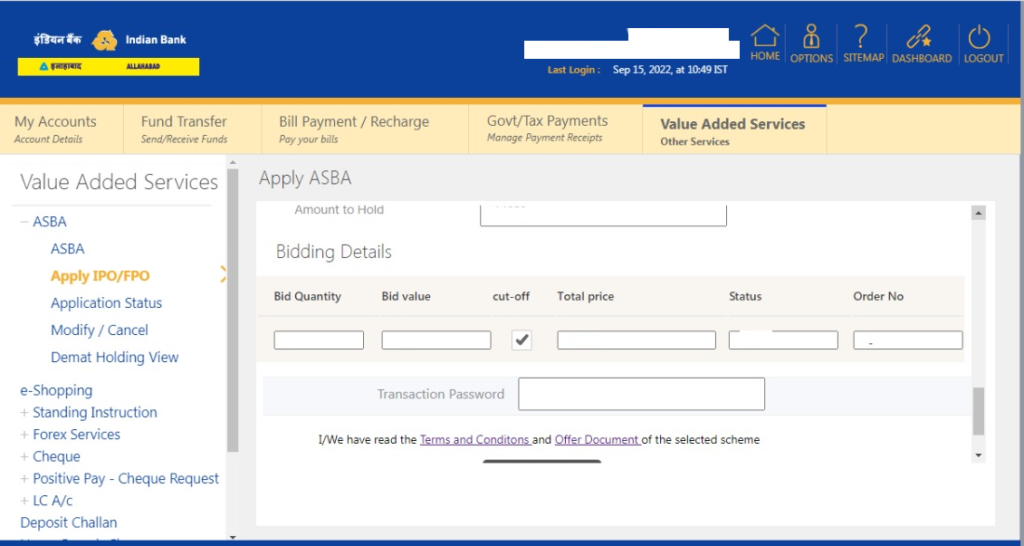
PROCESS FOR APPLYING IN AN IPO THROUGH INDIAN BANK

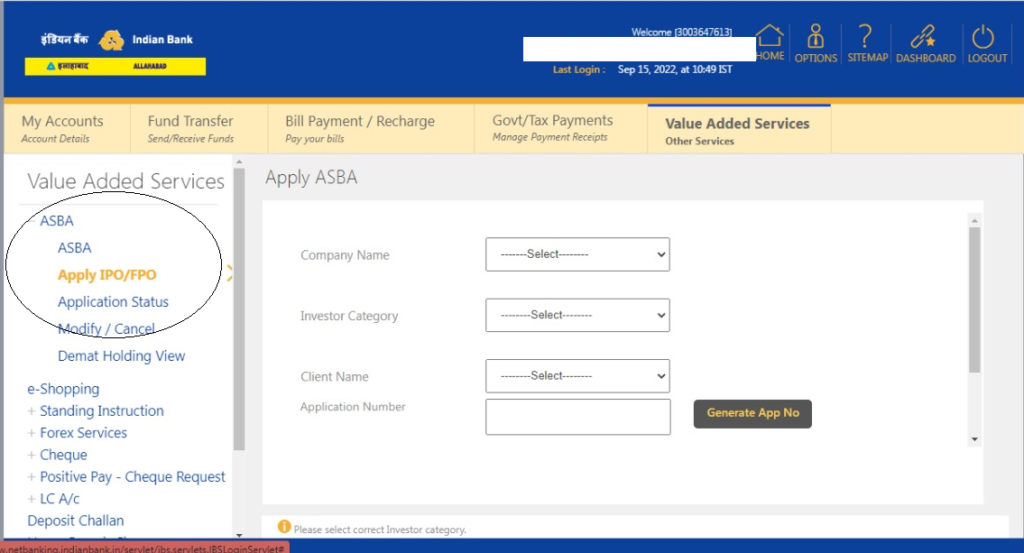
Step 1: Login to Net banking of Indian Bank. Click on ‘ASBA’ under “Value Added Services” tab.

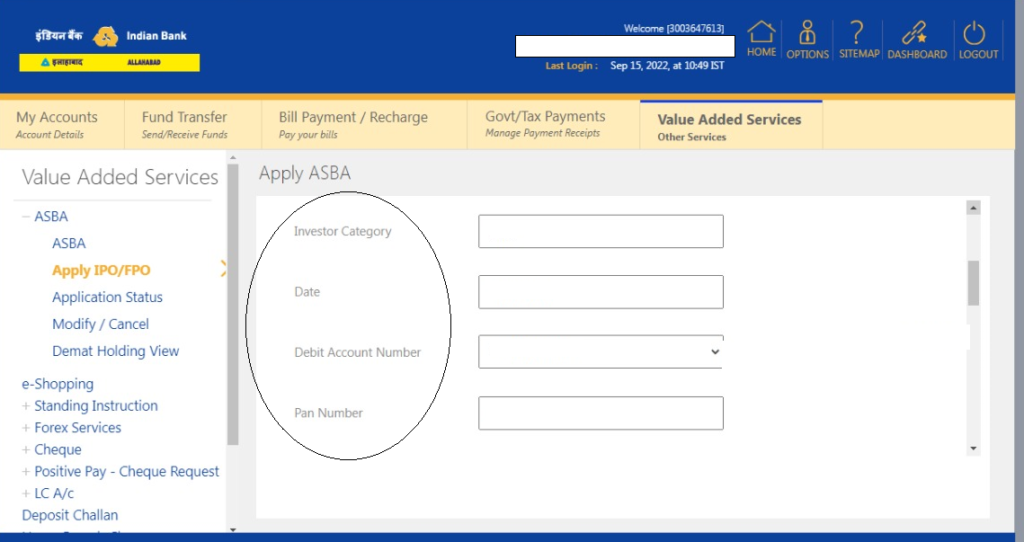
Step 2: Click on “Apply IPO/FPO”. Fill in the details and Generate Application Number for the same.

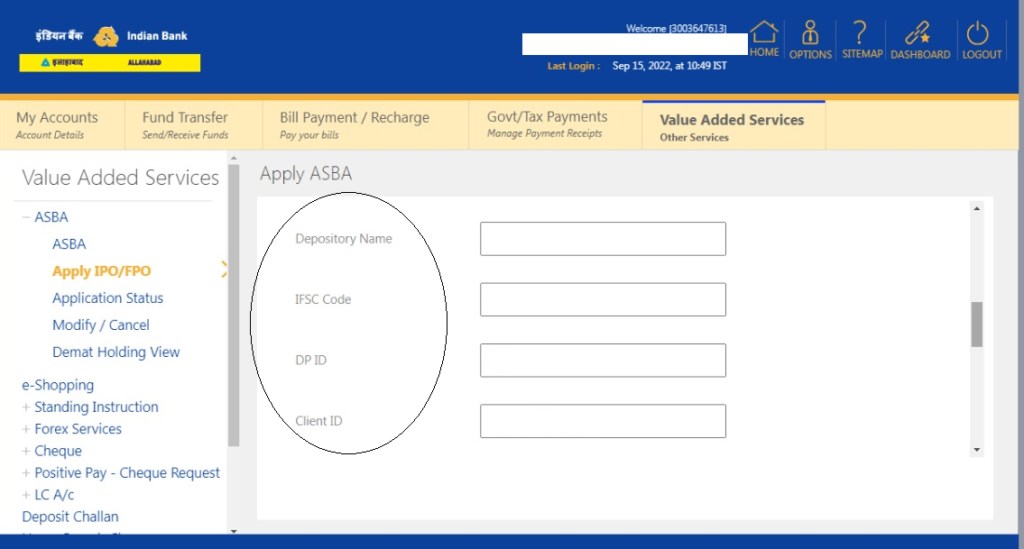
Step 3: Fill in the required details for application.

Step 4: Enter the details regarding the Quantity and Value for the Bid and complete the process by entering the Transaction Password.

CATEGORIES OF INVESTORS (RII, NII & QIB)

Initial Public Offering (IPO) is a process by which a privately held company gets listed on the stock exchange and sells its shares to investors. There are several categories of investors in IPO application process. You can apply through more than one category to maximize the chances of allotment based on the eligibility criteria.

RETAIL INDIVIDUAL INVESTORS

  • This category includes Resident Indian Individuals, Non-resident Indians (NRIs) and Hindu Undivided Families (HUFs)
  • The minimum allocation under the retail quota is 35%.
  • SEBI has decreed that if the issue is oversubscribed, subject to availability, all retail investors be allotted at least one lot of shares. A lottery system is used to allocate IPO shares to the public when one lot cannot be allocated to each investor.

NON INSTITUIONAL INVESTORS (includes HNI)

Institutional Bidders (NII) category includes IPO application by High Net-worth Individual (HNI) investors. Other than HNI investors, the NII reserved portion also includes:

  • NRIs
  • HUFs
  • Companies
  • FPIs, and
  • Trusts.

NIIs are further divided into two categories:

  • s-NII: NII investors who bid for shares between Rs. 2 lakhs and Rs. 10 lakhs are considered as Small NII category. The 1/3rd of NII category shares are taken for this sub-category. This subcategory is also called Small HNI (s-HNI).
  • b-NII: NII investors who bid for shares worth more than Rs 10 Lakhs are considered as Big NII category. The 2/3rd of NII category shares are taken for this sub-category. This subcategory is also called Big HNI (b-HNI).

HIGH NETWORTH INDIVIDUALS(HNI)

Non-Individual Investors, also known as HNIs are high-value applications and therefore are treated differently from retail applications.

  • HNI category allows investors to apply for more than Rs 2 lakh in an IPO.
  • HNI applications cannot be cancelled.
  • Modification of bids can be increased but cannot be reduced.
  • HNI investors can’t apply at the cut-off price. The applicants have to mention the exact price they are willing to pay for the IPO.

QUALIFIED INSTITUTIONAL BIDDERS (QIBs):

  • Commercial banks, public financial institutions, mutual fund houses and Foreign Portfolio Investors that are registered with SEBI fall in this category.
  • 50% of the total offer price is reserved for Qualified Institutional Bidders.
  • Investors from this category cannot bid at the cut-off price.
  • QIB’s are prohibited by SEBI guidelines to withdraw their bids after the close of the IPOs.

Underwriters try to sell large sums of IPO shares to qualified investors/bankers at a thriving price before the start of the listing of IPO. To meet the targeted capital of any company, underwriters sell a huge amount of shares to QIBs. SEBI mandates that institutional investors shall sign a lock–up agreement for at least 90 days to guarantee minimal volatility during the IPO process. QIBs are particularly significant for a company launching an IPO. That’s because IPO shares are offered by the underwriters to the QIBs before the price discovery in the share market takes place. There would be lesser number of shares available to the general public if QIBs buy more shares. This would result in increased share prices. This scenario is great for a company because they want to raise as much as capital as possible.

However, SEBI has laid down rules to ensure that companies do not manipulate the IPO valuations. Because of this, SEBI doesn’t allow the companies to allocate more than 50% shares to Qualified Institutional Bidders (QIBs).

ANCHOR INVESTORS

This is a part of QIB making an application of more than Rs.10 crores in a book building issue. This category includes

  • Resident Indian Individuals, non-resident Indians (NRIs), HUFs, companies, trusts, science institutions, corporate bodies and societies.
  • Investors under this category cannot bid at the cut-off price.
  • Maximum 60% of the QIB category can be allocated to the Anchor Investors.
  • Anchor Investor Offer Price is decided separately.
  • No merchant banker, promoter or their relatives can apply for shares under the anchor investor category.

POINTS TO BE REMEMBERED:

  • UPI transaction limit for the payment of IPO has been increased from Rs.2 Lakhs to Rs.5 Lakhs for the investors with effect from 1st May, 2021.
  • There is a time limitation for bidding. Applications are allowed till 3:45 PM IST only. Bids placed after 3:45 PM on Day 1 and Day 2 will be pushed as AMO orders. On Day 3, bids placed after 3:45 PM will be rejected by the exchange automatically but it can vary depending upon the policies of the bank.
  • IPO allotment is done on a lottery or proportionate basis depending on the status of oversubscription in the segment.

KEY DIFFERENCES

PARTICULARSRIINII/HNIQII
ELIGIBILITYResident Indian individuals and NRIs applying for shares not exceed Rs 2 Lakh in value.Resident Indian individuals and NRIs applying for shares exceed Rs 2 Lakh in value.Commercial banks, public financial institutions, mutual fund houses and Foreign Portfolio Investors that are registered with SEBI (More than Rs. 2 Lakhs)
SHARES AVAILABLE35% of the Offer15% of the Offer.50% of the Offer.
BASIS OF ALLOTMENTLotteryProportionateProportionate
CUT-OFF PRICECan invest at the cut-off price.Cannot invest at the cut-off price.Cannot invest at the cut-off price
BIDSRetail investors are allowed to withdraw or lower the bidsCannot withdraw or lower the bids.Cannot withdraw or lower the bids.