Gold is one of the most preferred investment options in India, available in multiple forms such as physical gold, Gold ETFs, Sovereign Gold Bonds (SGBs), digital gold, and gold mutual funds. Each form has a different tax treatment under the Income-tax Act. This article explains the taxation on sale of gold in a simple and professional manner.
1. Physical Gold (Jewellery, Coins & Bars)
Physical gold includes jewellery, coins, and bars. Tax is applicable at the time of sale based on the holding period.
• Short-Term Capital Gain (STCG): If sold within 24 months, gains are taxed as per the individual’s income tax slab. • Long-Term Capital Gain (LTCG): If held for more than 24 months, gains are taxed at 12.5% without indexation. • GST paid at the time of purchase is not refundable and forms part of the cost.
2. Gold Exchange Traded Funds (ETFs)
Gold ETFs are paper gold investments traded on stock exchanges and backed by physical gold.
• STCG: Units sold within 12 months are taxed as per income tax slab rates. • LTCG: Units sold after 12 months are taxed at 12.5% without indexation.
3. Sovereign Gold Bonds (SGBs)
Sovereign Gold Bonds are issued by the RBI on behalf of the Government of India and are considered the most tax-efficient form of gold investment.
• If held till maturity (8 years): Capital gains are completely tax-free. • If sold on stock exchange: – Within 12 months: Taxed at slab rates. – After 12 months: Taxed at 12.5% without indexation. • Interest earned (around 2.5% annually) is taxable as per slab rates.
Amendment in Finance Bill, 2026 “exemption will be applicable only to those Sovereign Gold Bonds issued by the Reserve Bank of India that are subscribed to by an individual at the time of original issue and are held continuously by such individual until redemption upon maturity” it means Capital gains exemption does not apply if bought from secondary market.
4. Digital Gold & Gold Mutual Funds
Digital gold and gold mutual funds offer convenience and flexibility but follow similar tax rules.
• STCG: If sold within 24 months, gains are taxed as per income tax slab. • LTCG: If sold after 24 months, gains are taxed at 12.5% without indexation.
Conclusion:
From a tax perspective, Sovereign Gold Bonds are the most efficient option for long-term investors, while Gold ETFs and mutual funds provide liquidity with moderate taxation. Physical gold, though culturally significant, is the least tax-efficient due to GST and higher holding period requirements.
In Tabular Format
Investment type
Short-term capital gains (STCG)
Long-term capital gains (LTCG)
Notes
Sovereign Gold Bonds (SGBs)
If sold within 12 months: taxed at slab rate
If held beyond 12 months and sold before maturity: 12.5% without indexation; Nil if held till 8-year maturity
Capital gains exemption does not apply if bought from secondary market
Gold ETFs
Up to 12 months: taxed at slab rate
Beyond 12 months: 12.5% without indexation
Treated as listed securities
Gold mutual funds
Up to 24 months: taxed at slab rate
Beyond 24 months: 12.5%
Usually invest in gold ETFs
Physical gold
Up to 24 months: taxed at slab rate
Beyond 24 months: 12.5%
GST paid cannot be set off against capital gains tax
Gifted gold
Taxable only if gift from non-relatives exceeds ₹50,000
Taxable in the recipient’s hands
Gifts from specified relatives are tax-free
Inherited gold
Capital gains apply on sale
Capital gains apply on sale
Original owner’s cost and holding period are considered
India’s labour law landscape has undergone its most profound transformation in decades with the implementation of the four new Labour Codes, effective from 21 November 2025. This historic move rationalizes 29 existing labour statutes into a streamlined and modern framework. The aim is to simplify and streamline regulations, enhance workers’ welfare, align the labour ecosystem with global standards, and lay the foundation for a future-ready workforce, boosting employment and driving reforms for Aatmanirbhar Bharat.
The key provisions include universal minimum wages, standardized working conditions, broadened social security coverage, and simplified industrial dispute procedures.
The Four Pillars of Reform
The government has brought into force the key provisions of four consolidated codes:
1. Code on Wages, 2019: Focuses on wages, bonus, and equal remuneration.
2. Industrial Relations Code, 2020: Deals with trade unions, standing orders, and dispute resolution.
3. Code on Social Security, 2020: Expands coverage for benefits like PF, ESI, Gratuity, and includes gig workers.
4. Occupational Safety, Health & Working Conditions (OSHWC) Code, 2020: Covers safety, health, and welfare, including rules for working hours and women’s employment.
The new framework introduces several themes designed to unify compliance across all establishments:
Theme
Summary of Change
Unified Definition of “Wages”
Wages comprise basic pay, dearness allowance, and retaining allowance minus specified exclusions. Exclusions are capped, meaning at least 50% of the employee’s Cost-to-Company (CTC) must be counted as wages for calculating benefits like PF, gratuity, and overtime.
Single Registration & Return
Establishments register once on the Shram Suvidha portal and file a consolidated return instead of multiple returns under different laws.
Inspector-cum-Facilitator
Traditional inspectors are re-designated as “facilitators” who advise employers on compliance. They conduct risk-based digital inspections and still hold powers to issue notices and inspect records.
Decriminalisation & Compounding
Many procedural offences have been decriminalized. First-time minor procedural offences can often be compounded by paying 50% of the maximum fine, promoting compliance over punitive action.
Digital Compliance
Employers are permitted to maintain registers and submit forms electronically, primarily through the Shram Suvidha portal.
Key Features of the Four Labour Codes:
The following table summarizes the core mandates and applicability thresholds for the four codes:
Code
Core Provisions and Features
Applicability Highlights
Code on Wages, 2019
National Floor Wage: Central government notifies a floor wage that states cannot set minimum wages below. Wages must be reviewed at least every five years. Equal Remuneration: Enforces equal pay for equal work irrespective of gender or transgender status. Overtime: Must be paid at double the ordinary wage for work beyond 8 hours/day or 48 hours/week. Final Settlement (FnF): Requires settlement of all wages and dues (including salary and leave encashment) within two working days of dismissal, retrenchment, removal, or voluntary resignation.
Applies to all employees in organized and unorganized sectors, covering factories, shops, IT/ITES, and gig workers.
Industrial Relations Code, 2020
Standing Orders: Mandatory for employers with 300 or more workers (covering service rules like classification, hours, and misconduct). Lay-off/Closure: Establishments with 300+ workers require prior government permission for lay-off (15 days notice), retrenchment (60 days notice), or closure (90 days notice). Grievance Redressal Committee (GRC): Mandatory for establishments with 20+ workers, requiring equal worker and management representation, including at least one woman representative. Dispute Resolution: Accelerated process through two-member tribunals; parties can approach directly if conciliation fails within 90 days.
Applicability threshold for certain provisions (like standing orders) is 300 workers. Extends the definition of “worker” to include sales promotion staff and supervisory employees earning up to about ₹18,000/month.
Code on Social Security, 2020
Gig & Platform Workers: Recognizes these workers; aggregators must contribute 1–2% of annual turnover (capped at 5% of payments to workers) to a social security fund. Gratuity: Fixed-term employees become eligible for gratuity after one year of service. Maternity Benefit: Retains 26-week paid leave and mandates crèche facilities for establishments with 50 or more employees. EPF & ESIC: Coverage is extended Pan-India and made voluntary for establishments with fewer than 10 employees, but mandatory for hazardous industries regardless of size.
Applies to all establishments, employees, and workers, including unorganised, gig, and platform workers.
OSHWC Code, 2020
Working Hours: Normal working day limited to eight hours. Employment of Women: Removes blanket prohibitions; women may work night shifts and in all types of establishments, including mines, with their consent and subject to safety conditions like safe transport and security. Health & Welfare: Mandatory annual health check-ups for workers aged over 40. Safety Committees: Mandatory in establishments employing 500 or more workers.
Covers factories (with revised thresholds: 20 workers w/ power or 40 w/o power), mines, plantations, contract labour, and migrant workers.
The reforms are designed to extend protections to vulnerable and non-traditional employment sectors:
Worker Category
New Benefit/Protection under the Codes
All Workers
Mandatory appointment letters to ensure transparency, job security, and formal employment. Statutory right to minimum wage and timely payment.
Gig & Platform Workers
Mandatory social security coverage and defined contribution model from aggregators. Aadhaar-linked Universal Account Number (UAN) for portable benefits.
Fixed-Term Employees (FTE)
Eligible for all benefits (leave, medical, social security) equal to permanent workers. Gratuity eligibility after only one year of continuous service.
Women Workers
Permitted to work night shifts and in all types of work (including underground mining) subject to consent and safety measures. Explicit prohibition of gender discrimination and guarantee of equal pay for equal work.
Inter-State Migrant Workers
Defined to cover self-migrated workers; receive annual travel allowance, portability of ration and social security benefits, and access to a toll-free helpline.
Practical Obligations for Employers:
The implementation of the Codes places greater responsibilities on employers, particularly concerning payroll and HR procedures. Employers must revise their operations to ensure compliance:
• Review Wage Structure: Salary components must be reworked to ensure that at least 50% of CTC is classified as “wages” to avoid penalties related to PF/bonus liability misclassification.
• Establish FnF Workflow: Companies should adopt a strict T+2 working day internal standard for full-and-final settlement upon an employee’s exit (resignation, termination, etc.).
• Update Registration: Register on the Shram Suvidha portal (Form II) to obtain a single Labour Identification Number (LIN).
• Maintain Records: Issue wage slips (Form V) and maintain statutory registers electronically, including those for fines (Form I), deductions (Form IV), employee details (Form VI), and attendance/wages/overtime (Form VII).
• Safety Compliance: Conduct periodic safety audits, provide free annual medical check-ups for workers over 40, and supply Personal Protective Equipment (PPE) and training.
Failure to Comply: particularly regarding non-payment of minimum wages or delayed remittance of contributions (PF/ESI), can lead to serious penalties, including fines up to ₹50,000 for first offences or imprisonment for repeat violations or serious negligence causing death.
The four labour codes represent a paradigm shift aimed at fostering a fair, safe, and productive work environment by simplifying the fragmented laws and expanding the social safety net.
Q&A: New Labour Codes
1. What are the New Labour Codes?
The Government of India has consolidated 29 existing labour laws into four major Labour Codes:
Code on Wages, 2019
Industrial Relations Code, 2020
Occupational Safety, Health and Working Conditions (OSH) Code, 2020
Social Security Code, 2020
2. When will the new labour codes come into effect?
The codes are scheduled to be implemented from 21 November 2025 across India.
3. Why were labour laws consolidated?
To:
Simplify compliance
Improve ease of doing business
Provide uniform definitions
Protect workers with updated standards
Enable digital and transparent systems
4. Who will be covered under the new labour codes?
The Codes apply to:
All establishments
All employees (skilled, unskilled, managerial, operational)
Contract labour
Gig and platform workers (under Social Security Code)
Inter-state migrant workers
5. What is the biggest reform introduced under the Code on Wages?
A universal definition of wages that applies across all labour laws—affecting PF, gratuity, leave encashment, and salary structuring.
6. What is the new definition of “Wages”?
“Wages” include basic pay + DA + retaining allowance, capped at a minimum of 50% of total CTC. Allowances cannot exceed 50%. If allowances exceed 50%, the excess will be added back into “wages”.
Salaried individuals who engage in stock trading or Futures & Options (F&O) transactions often have queries about income tax return filing, applicability for maintaining Books of Accounts and the applicability of tax audit on F&O transactions. This guide provides an in-depth analysis based on the latest provisions under the Income Tax Act, 1961.
Understanding Trading Transactions for Taxation
Trading in stocks or F&O can be broadly classified into two categories:
Speculative Business Transactions
Non-Speculative Transactions (F&O Trading)
1. Speculative Transactions:
As per Section 43(5) of the Income Tax Act, a speculative transaction is one where the purchase and sale of stocks or commodities are settled without actual delivery. Intraday trading in equities falls under this category.
2. Non-Speculative Transactions (F&O Trading):
F&O trading, including commodity derivatives on recognized stock exchanges, is treated as non-speculative business income even though no physical delivery takes place.
Applicability of Tax Audit for F&O Trading
Since F&O trading is considered business income, tax audit provisions under Section 44AB apply similarly to any other business income. Understanding the turnover limits and profit declaration rules is crucial for compliance.
When is Tax Audit Mandatory?
Tax audit under Section 44AB is applicable in the following cases:
Turnover up to Rs. 1 crore:
Tax audit is not required, regardless of profit or loss, provided Section 44AD(4) does not apply.
Turnover exceeding Rs. 1 crore but up to Rs. 10 crore:
Tax audit is not required if at least 95% of transactions are digital.
Tax audit is mandatory if cash transactions exceed 5% of total receipts or 5% of total payments.
Please Note Receipts and payments are calculated separately, not cumulatively.
Turnover above Rs. 10 crore:
Tax audit is mandatory, irrespective of profit or loss.
Presumptive Taxation (Section 44AD) and Tax Audit:
If a taxpayer opts for Section 44AD, no tax audit is required for turnover up to Rs. 3 crore from Financial Year 2023-24 (Assessment Year 2024-25).
However, if Section 44AD(4) applies, tax audit is required if the declared profit is less than 6% (digital) or 8% (cash) of turnover, and total income exceeds the basic exemption limit.
Tax Audit for Professionals Under Section 44ADA and F&O Traders
If a taxpayer is carrying on a profession eligible for presumptive taxation under Section 44ADA and simultaneously engaged in F&O trading, the tax audit requirement is determined separately for each activity:
For F&O trading, tax audit is applicable as per Section 44AB turnover limits discussed above.
For professionals under Section 44ADA, tax audit is applicable if gross receipts exceed Rs. 75 lakh from Financial Year 2023-24 (Assessment Year 2024-25).
If both activities are carried out simultaneously, each must be evaluated independently for tax audit applicability.
How to Calculate Turnover for F&O Trading?
Determining turnover for tax audit purposes is essential for accurate reporting. The method of turnover calculation varies based on the type of transaction:
Futures and Options (F&O) Trading: Turnover is calculated as the sum of absolute values of profits and losses from each squared-off trade during the financial year.
Options Trading: If an options contract is physically settled, the premium received on the sale is included in turnover computation.
Turnover Calculation as per ICAI Guidance Note: The calculation of turnover for tax audit purposes is guided by ICAI’s Guidance Note on Tax Audit. This method ensures uniformity in turnover computation and compliance with audit requirements.
Understanding the 5% Cash Transaction Clause Under Section 44AB
For businesses with turnover between Rs. 1 crore and Rs. 10 crore, tax audit is not required if cash receipts and cash payments do not exceed 5% of total transactions. This is computed separately as follows:
Aggregate of all cash receipts, including sales, should not exceed 5% of total receipts.
Aggregate of all cash payments, including expenses, should not exceed 5% of total payments.
If either of these conditions is violated, tax audit becomes mandatory.
Since turnover is below Rs. 1 crore, no tax audit is required unless Section 44AD(4) applies.
When is Books of Accounts Mandatory to maintain?
The Income Tax Act has specified the books of accounts that are required to be maintained for the purpose of Income Tax. These have been prescribed under section 44AA and Rule 6F.
In case business/profession is being carried out by the individual or HUF the limits are increased as under:
a. For Income – Limit is Rs. 2,50,000
b. For Turnover/Gross Receipt – Limit is Rs. 25,00,000
Tax Benefits on Losses in F&O Transactions
Losses incurred in Futures & Options (F&O) transactions can be set off against rental or interest income. Any unadjusted losses can be carried forward for up to eight years and offset against future business profits, including profits from F&O transactions.
Is Declaring F&O Loss in the Income Tax Return is Mandatory
Many taxpayers, particularly salaried individuals engaged in F&O trading, often fail to report these transactions in their income tax returns. This omission may occur due to ignorance, but it is crucial to note that reporting all sources of income is a legal requirement.
Brokers are mandated to report all security transaction details to the Income Tax Department by filing a Statement of Financial Transactions (SFT) annually. Non-disclosure of F&O transactions can attract scrutiny from the department, resulting in notices for non-compliance and potential penalties for failure to maintain books of accounts and non-filing of the required tax audit report along with the income tax return.
Notice Under Section 139(9) of the Income Tax Act (Defective Return)
Failure to furnish a Balance Sheet and Profit & Loss Account when required can lead to receiving a notice under Section 139(9) from the Centralized Processing Centre (CPC) of the Income Tax Department. The notice typically states:
“The assessee has claimed loss under the head ‘Profits and Gains of Business or Profession’; however, a Balance Sheet and Profit & Loss Account must be provided. If the assessee falls under Section 44AD/44AE/44ADA, the books of account must be audited if the income offered is below the prescribed limits as per the provisions of the Income Tax Act.”
While an audit is not mandatory if the turnover is below INR 1 crore, the income tax return must be duly filed with a complete Balance Sheet and Profit & Loss Account under Section 139 of the Income Tax Act.
Table in Glance:
Scenarios
Opted for 44AD
Declaring Profit
Remarks
1
Yes (Turnover is less than Rs. 2Cr.)
According to 44AD
Neither require to maintain books of accounts nor audit.
2
Yes (Turnover is less than Rs. 2Cr.)
Less than 8% or 6% as the case may be or declaring loss.
Require to maintain books of accounts and audit.
3
No (Turnover is less than limit given u/s 44AB)
Profit or loss whatever is the case.
No audit, maintain books of accounts if limit of 44AA is crossed.
4
No (Turnover is more than limit given u/s 44AB)
Profit or loss whatever is the case.
Audit and maintaining books of accounts is mandatory.
Note: In all the cases of loss audit is not mandatory. It depends case to case. But in general practice and to deal with future litigation this practice followed.
Disclaimer: This article is solely for educational purpose and cannot be construed as legal and professional opinion. It is based on the interpretation of the author and are not binding on any tax authority. Author is not responsible for any loss occurred to any person acting or refraining from acting as a result of any material in this article.
A Gilt Fund is a type of debt mutual fund that primarily invests in government securities (G-secs). These are bonds issued by the central and/or state governments to borrow money. As such, gilt funds carry zero credit risk, since they are backed by sovereign guarantee, but they are sensitive to interest rate movements.
Key Features of Gilt Funds:
Feature
Description
Underlying Securities
Government bonds (short to long-term maturity)
Risk Level
Low credit risk, but high interest rate risk
Return Expectation
Moderate returns, typically 5–7% p.a. over medium to long term
Investment Horizon
Ideal for 3–5 years or more
Liquidity
High, as most gilt funds are open-ended
Regulation
Regulated by SEBI
🔹 What is a Gilt Fund Account?
A Gilt Fund Account is a folio or investment account through which an investor can:
• Invest in one or more gilt funds
• Monitor NAV, holdings, and returns
• Redeem or switch between debt schemes
It may be referred to as a Mutual Fund Account with exposure specifically to Gilt Funds. Some platforms also offer direct gilt investments via RBI Retail Direct Gilt Account, allowing investors to buy G-Secs directly from RBI.
RBI Retail Direct’:
As part of continuing efforts to increase retail participation in government securities, ‘the RBI Retail Direct’ facility was announced in the Statement of Developmental and Regulatory Policies dated February 05, 2021 for improving ease of access by retail investors through online access to the government securities market – both primary and secondary – along with the facility to open their gilt securities account (‘Retail Direct’) with the RBI.
In pursuance of this announcement, the ‘RBI Retail Direct’ scheme, which is a one-stop solution to facilitate investment in Government Securities by individual investors is being issued today. The highlights of the ‘RBI Retail Direct’ scheme are:
i. Retail investors (individuals) will have the facility to open and maintain the ‘Retail Direct Gilt Account’ (RDG Account) with RBI.
ii. RDG Account can be opened through an ‘Online portal’ provided for the purpose of the scheme.
iii. The ‘Online portal’ will also give the registered users the following facilities:
Access to primary issuance of Government securities
Access to NDS-OM.
🔄 Gilt Funds vs Share Market – A Comparison
Particulars
Gilt Funds
Share Market (Equity Investment)
Nature of Investment
Government bonds (debt instruments)
Equity shares of listed companies
Risk Level
Low credit risk, high interest rate risk
High market, business & volatility risk
Returns
Moderate & stable (linked to interest rates)
Potentially high but volatile
Ideal for
Conservative or debt-oriented investors
Growth-seeking and risk-tolerant investors
Investment Horizon
Medium to long-term
Long-term (ideally >5 years)
Volatility
Low to moderate
High
Regulation
SEBI, RBI
SEBI, Stock Exchanges
Liquidity
High in open-ended funds
High for listed shares
Taxation (LTCG >2Y)
12.5% with indexation (for funds held >2 years)
12.5% LTCG on gains > ₹1.25 lakh
📈 Who Should Invest in Gilt Funds?
• Investors looking for safety of capital with moderate returns • Suitable during falling interest rate cycles (bond prices rise) • Ideal for diversification in low-risk portfolios
⚠️ Risks to Consider
• Interest Rate Risk: As rates rise, bond prices fall, affecting NAV. • No Credit Risk, but duration risk is higher in long-term gilt funds. • Not ideal for short-term parking due to volatility from rate changes.
📑 Source References:
1. SEBI – Mutual Funds Regulations: https://www.sebi.gov.in
2. RBI Retail Direct Scheme: https://rbiretaildirect.org.in
3. AMFI – Gilt Fund Details: https://www.amfiindia.com/investor-corner/knowledge-center/types-of-mutual-funds
Disclaimer: This article is solely for educational purpose and cannot be construed as legal and professional opinion. It is based on the interpretation of the author and are not binding on any tax authority. Author is not responsible for any loss occurred to any person acting or refraining from acting as a result of any material in this article.
The Professional Tax Registration Certificate (PTRC) is a statutory requirement for employers in Maharashtra under the Maharashtra State Tax on Professions, Trades, Callings and Employments Act, 1975. PTRC pertains to the professional tax that an employer deducts from the salaries of employees and remits it to the Maharashtra Government.
Applicability
Every employer who has even one employee drawing a salary exceeding ₹7,500 per month (₹10,000 for women employees) is required to register under PTRC and deduct professional tax from employee salaries. The employer must deposit this tax with the Maharashtra State Government. Separate PTRC registrations are required for each branch office if located in different jurisdictions.
PTRC Slab Rates (FY 2024-25)
The slab rates for PTRC deduction in Maharashtra are as follows: – Salary up to ₹7,500 per month (₹10,000 for women): Nil – Salary between ₹7,501 and ₹10,000: ₹175 per month – Salary above ₹10,000: ₹200 per month (except ₹300 in February) The total annual liability per employee cannot exceed ₹2,500.
Registration Process
Employers must register online through the Maharashtra Goods and Services Tax (MGST) portal at https://mahagst.gov.in. Under the e-Services section, they should choose ‘New Registration’ and select ‘PTRC’. Form I must be filled out with employer and employee details. Required documents typically include PAN, Aadhaar, address proof, and salary structure. Upon submission, the PTRC number is usually issued within 1 working day.
Payment and Return Filing
Employers must file returns and make payments on the MGST portal. The return Form IIIB is auto-generated upon payment. Filing frequency depends on the tax liability in the previous financial year: – Monthly: If liability > ₹1,00,000 – Quarterly: If liability ≤ ₹1,00,000 – Annual: For employers registered after 31 March 2020 with monthly tax liability of ₹2,500 Due dates are the 30th of the following month for monthly/quarterly returns and 31st March for annual returns.
Penalties and Interest for Non-Compliance
Failure to register, deduct, or pay PTRC can result in interest and penalties. Interest is charged at 1.25% per month for delays. Late filing of returns attracts a penalty of ₹1,000 per return. Non-registration or non-payment can lead to penalties up to the amount of tax due, along with possible prosecution.
Difference Between PTRC and PTEC
PTRC is related to the tax deducted by an employer from employees, whereas PTEC (Professional Tax Enrollment Certificate) is applicable to individual professionals, proprietors, and business owners, who must pay professional tax on their own behalf. Many businesses require both PTRC and PTEC registrations.
PTRC compliance is crucial for all employers in Maharashtra to ensure legal compliance and avoid penalties. Timely registration, accurate deduction, and proper return filing are essential. Employers are encouraged to integrate professional tax compliance into their payroll processes or seek assistance from professionals for smooth operations.
Disclaimer: This article is solely for educational purpose and cannot be construed as legal and professional opinion. It is based on the interpretation of the author and are not binding on any tax authority. Author is not responsible for any loss occurred to any person acting or refraining from acting as a result of any material in this article.
Form 10-IEA is required to fill by individuals or HUFs those want to continue with the old tax regime in the present financial year ie FY 2023-24. The Budget 2023 proposes that from FY 2023-24, the new tax regime will be considered the default tax regime. By filling Form 10-IEA, taxpayers can choose the old tax regime. They must file the form on or before the due date prescribed for filing an income tax return. Let’s start with the detailed analysis of Form 10-IEA and go through its important aspects.
What is Form 10-IEA
In FY 2022-23 the old tax regime was announced as the default tax regime. Those taxpayers willing to choose the New tax regime must have to file Form 10-IE electronically. But in FY 2023-24 the new tax regime was announced as the default tax regime. And now those taxpayers willing to choose the New tax regime must have to file Form 10-IEA electronically and this action make Form 10-IE which was earlier employed to opt for the new tax regime has now been discontinued
Purpose of Filing Form 10-IEA
let’s understand the purpose of Form 10IEA.
Individuals and HUF’s having income from profession/business must file Form 10-IEA by adhering to the prescribed deadline under Section 139(1). Please note this revised procedure streamlines the process, enabling individuals without business or professional income to directly specify their preference while filing a tax return by selecting the preferred option.
The corresponding choice determines the rules and regulations that would be applicable to the assessee.
Filling Form 10-IEA requires individuals to provide all the necessary information like PAN number, assessment year, name, and current status. These details can be used to accurately categorise and identify taxpayer information.
How to File Form 10-IEA
Follow these steps for filing Form 10-IEA online:
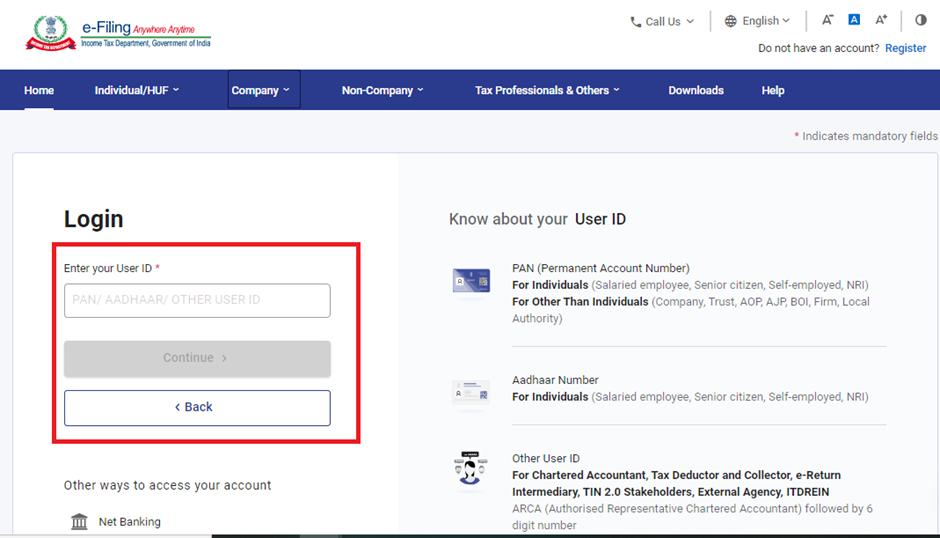
Step 1: Login on the e-filing portal
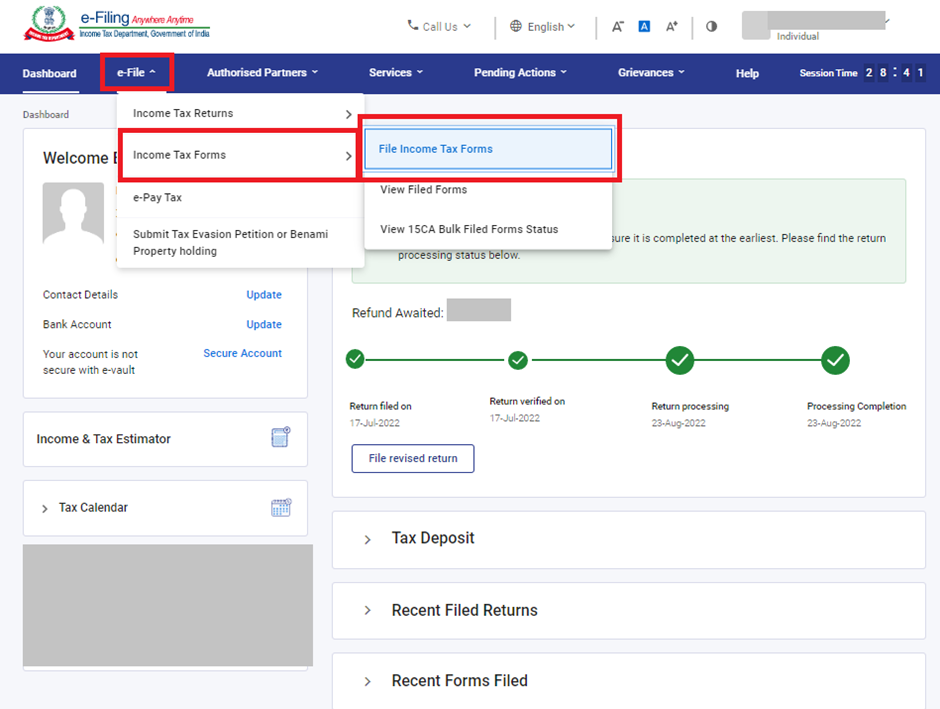
Step 2: On the dashboard, click ‘e-File’ > ‘Income tax forms’ > ‘File Income Tax Forms’
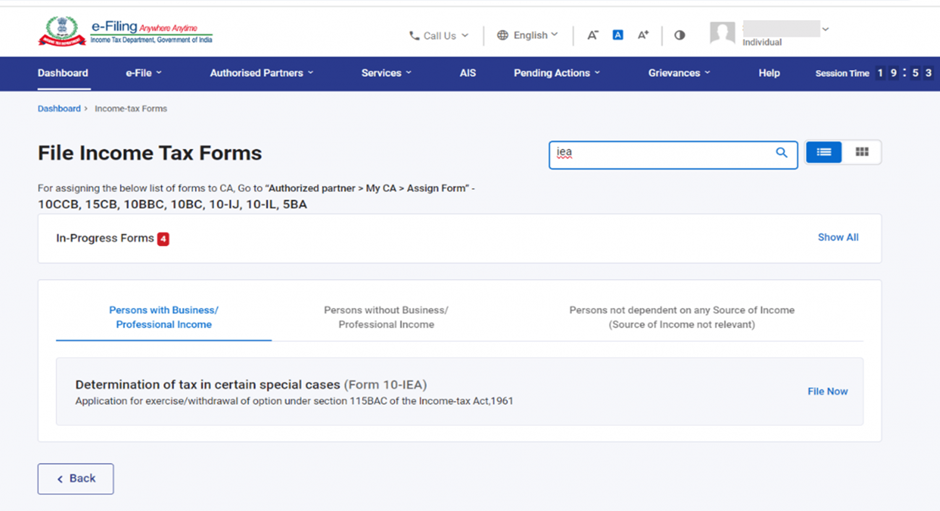
Step 3: Scroll down to select Form 10-IEA. Alternatively, enter Form 10-IEA in the search box. Click on ‘File now’ button to proceed.
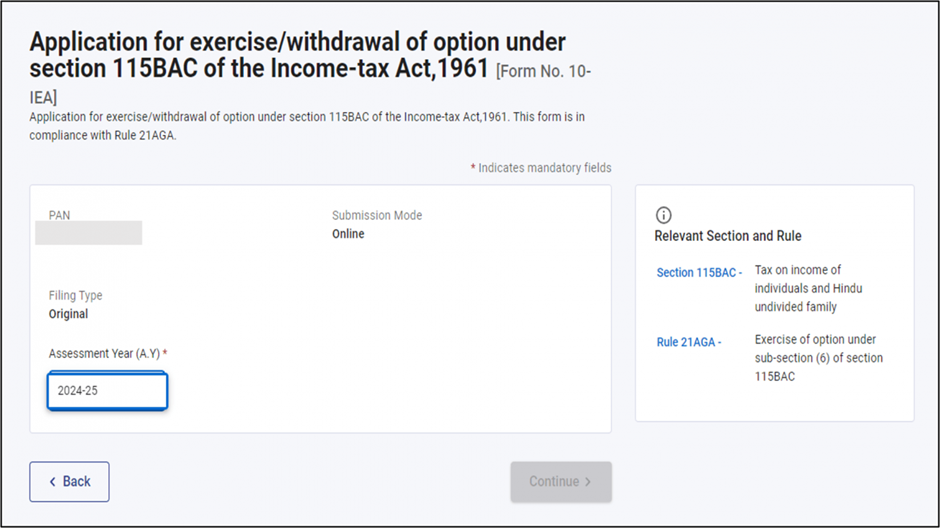
Step 4: Select the Assessment Year for which you are filing the return. For eg: If you are filing taxes for the income earned in FY 2023-24, then select AY 2024-25.
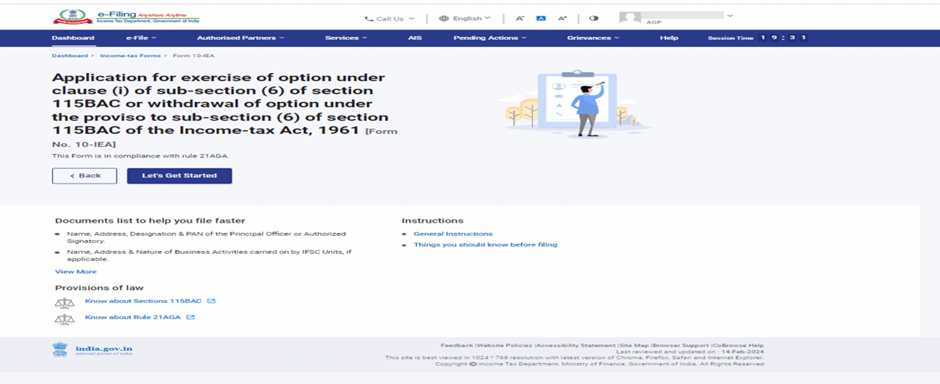
Step 5: After checking the documents required for filing the form click on ‘Let’s Get Started’.
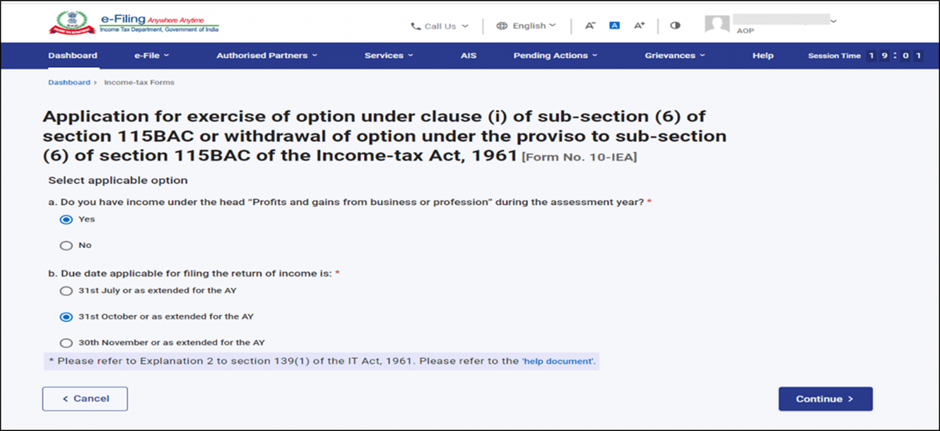
Step 6: Select “Yes” if you have Income under the head “Profits and gains from business or profession” during the assessment year. Select the due date applicable for filing of return of income and click on continue.
Note: Use “help document” by clicking on help document hyperlink for the help for selecting the applicable due date.
Step 7: Click ‘Yes’ to confirm the selection of the regime.
Step 8: Form 10-IEA has 3 sections. Verify and Confirm each section. They are as follows:
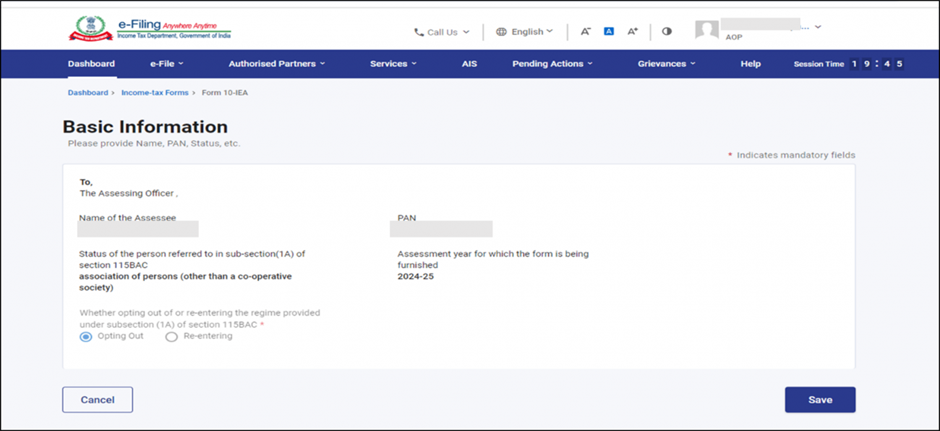
i. Basic Information: In Basic Informationsection, your basic information will be pre-filled. If you are filing form for the first time then opting out option will be auto-selected and if system has valid form with opting out option, then re-entering option will be auto-selected. Click on ‘Save’ button.
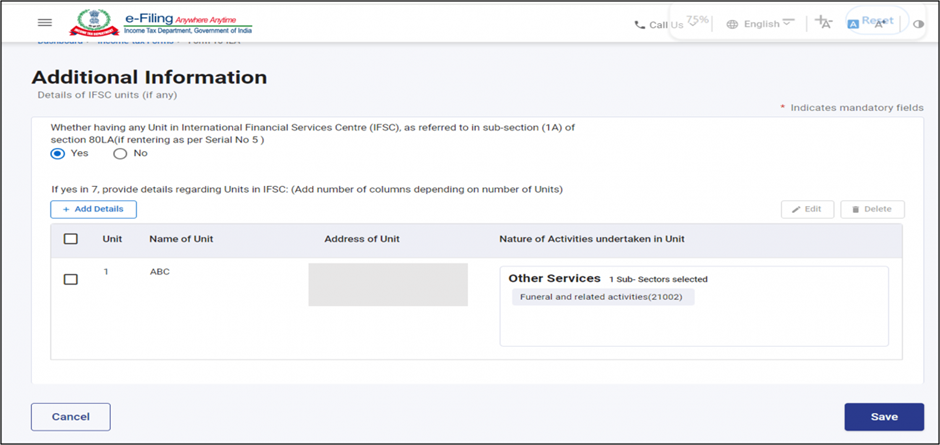
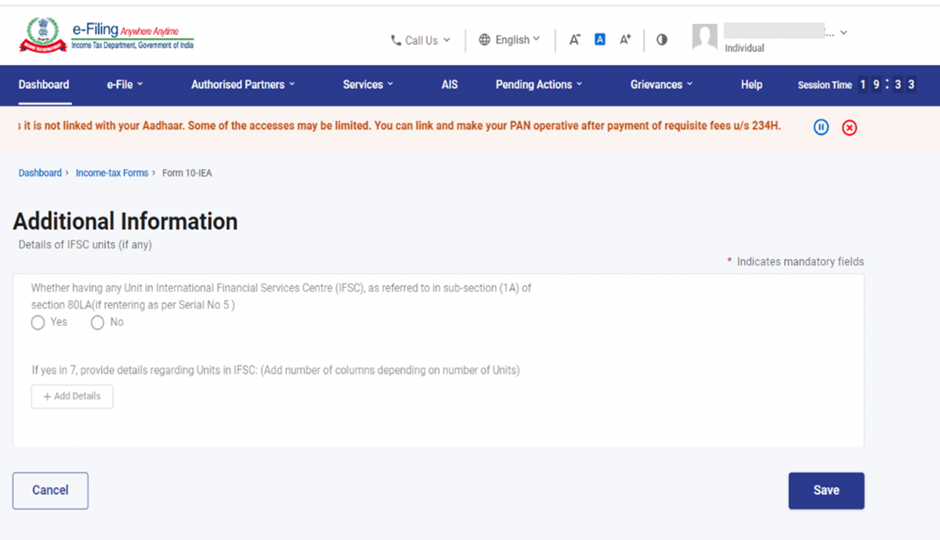
ii. Additional Information: Fill the necessary details in Additional information section related to IFSC unit (if any) and click on ‘Save’.
If you are opting out of new Tax regime this Additional Information panel will be greyed off
iii. Declaration and Verification: Verification section contains self-declaration where you will be required to check the boxes and agree to the terms and conditions. Verify whether all the details are correct and save the information. Once done, click on ‘Preview’ to review Form 10-IEA.
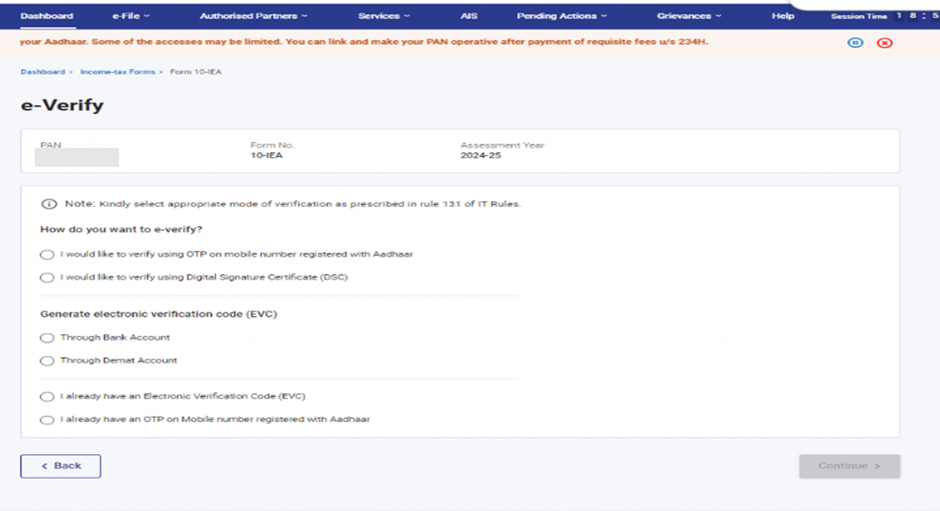
Step 9: After reviewing all the information, ‘Proceed’ to e-verify’. You can e-verify either through:
Aadhaar OTP
Digital Signature Certificate (DSC)
Electronic Verification Code (EVC)
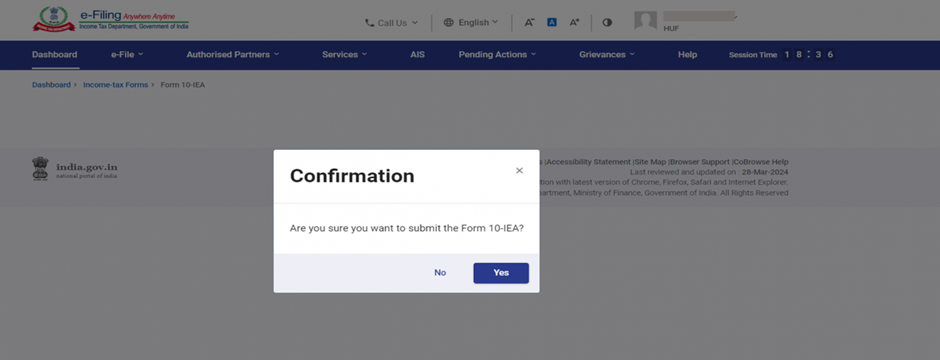
Step 10: After verification Click on ‘Yes’ to submit the Form.
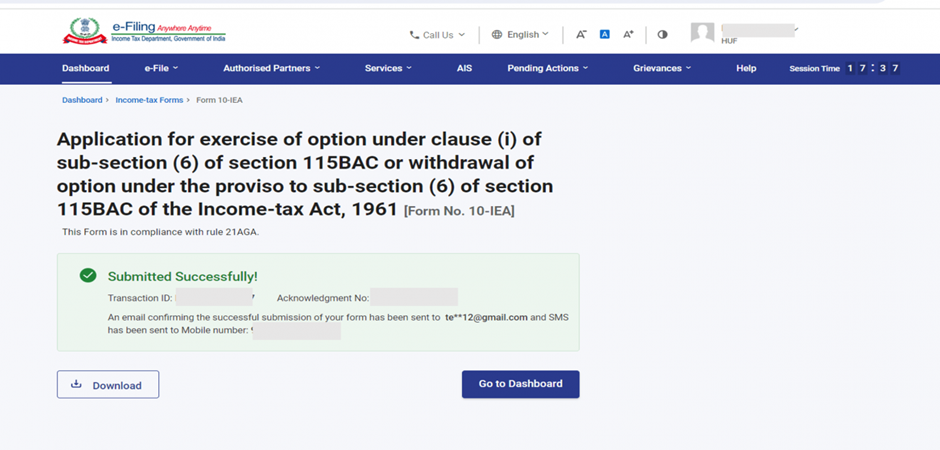
Step 11: After successful e-Verification, a success message is displayed along with a Transaction ID and an Acknowledgement Receipt Number. Please keep a note of the Transaction ID and Acknowledgement number for future reference. You can also download the form and locate the acknowledgment number. To download the filed form, go to ‘e-File’ → ‘Income Tax Forms’ → ‘View Filed Forms’.
The new section 43B(h) will be applicable from April 1, 2024 (AY 2024-25), Section 43B(h) of the Income Tax Act introduces significant changes concerning expenses related to purchases or services from Micro and Small Enterprises. Please note this section is not applicable on Medium Enterprises.
43B(h) has been inserted as a Socio-Economic Welfare Measure to ensure timely payments to micro and small enterprises.
We all know that section Section 43B of the Act provides for certain deductions to be allowed only on Actual Payment basis.
Finance Bill 2023 has newly inserted a clause to this section which is as under:
Section 43B (h) of Income Tax Act says:
“any sum payable by the assessee to a MICRO or SMALL enterprise beyond the time limit specified in 15 of the Micro, Small and Medium Enterprises Development Act, 2006,”
The above clause indicated that, in order to be eligible to claim deduction of the sum payable to micro and small enterprises, the payment shall be actually made within the time limit specified in 15 of the MSME Act, 2006.
Section 15 of MSME Development Act, 2006 says:
“Where any supplier supplies any goods or renders any services to any buyer, the buyer shall make payment therefor on or before the date agreed upon between him and the supplier in writing or, where there is no agreement in this behalf, before the appointed day*:
Provided that in no case the period agreed upon between the supplier and the buyer in writing shall not exceed forty-five days from the day of acceptance or the day of deemed acceptance”
It is very clear that, the buyer shall make the payment to the supplier as agreed between them, however the same cannot exceed beyond 45 days from date of acceptance or the day of deemed acceptance i.e., from the day of acceptance of the goods/service.
Section 2(b) of the MSME Development Act, 2006 says:
“Appointed Day” means the day following immediately after the expiry of the period of fifteen (15) days from the day of acceptance or the day of deemed acceptance of any goods or any services by a buyer from a supplier.
Explanation—For the purposes of this clause-
(i) “the day of acceptance” means-
(a) the day of the actual delivery of goods or the rendering of services; or
(b) where any objection is made in writing by the buyer regarding acceptance of goods or services within fifteen days from the day of the delivery of goods or the rendering of services, the day on which such objection is removed by the supplier;
(ii) “the day of deemed acceptance” means, where no objection is made in writing by the buyer regarding acceptance of goods or services within fifteen days from the day of the delivery of goods or the rendering of services, the day of the actual delivery of goods or the rendering of services;
Section 16 of MSME Development Act, 2006 says:
“Where any buyer fails to make payment of the amount to the supplier, as required under section 15, the buyer shall, notwithstanding anything contained in any agreement between the buyer and the supplier or in any law for the time being in force, be liable to pay compound interest with monthly rests to the supplier on that amount from the appointed day or, as the case may be, from the date immediately following the date agreed upon, at three times of the bank rate notified by the Reserve Bank”
Consequences upon Failure to make payment to Micro and Small Enterprises under Section 43B(h)
If the payment is made after 45 days or 15 days as specified – then expenses disallowed in the year and deduction will be available in the year in which the payment is made.
If the payment is due for more than 45 days or 15 days as specified but the payment is made before the end of the Financial Year – then in such case, the deduction of the expense will be available in the same year itself.
The classification of the enterprise as Micro, Small & Medium as defined in Micro, Small and Medium Enterprises Development Act, 2006 is hereby produced for your reference:
Section 92 of the Income Tax Act, 1961, deals with regulations of transfer pricing in India. It is a practice of determining the price of the transactions between associate enterprises and computation of Income from International transaction at Arm’s Length Price. This section has significant implications for Multi National Enterprises (MNE) operating in India and also on Specified Domestic Transaction (SDT).
Section 92E (Audit under Transfer Pricing):
Every person who has entered into an international transaction (IT) or specified domestic transaction (SDT) during a previous year shall obtain a report from an accountant (Chartered Accountant) and furnish such report on or before the “specified date” in the prescribed form (3CBE) duly signed and verified in the prescribed manner by such accountant and setting forth such particulars as may be prescribed.
Prescribed form for report from accountant is Form No. 3CEB. Under proviso to rule 12(2) audit report shall be furnished electronically.
“Specified date” means the date one month prior to the due date for furnishing the return of income under sub-section (1) of section 139 for the relevant assessment year.[Section 92F(iv)] As due date for ITR in transfer pricing cases is 30th November of the relevant assessment year, specified date is 31St October. Report from accountant (CA) will have to be furnished on or before 31st October of relevant assessment year in Form 3CEB.
PENALTY ON ASSESSEE FOR FAILURE TO FURNISH REPORT UNDER SECTION 192E [SECTION 271BA]
If any person fails to furnish a report from an accountant as required by section 92E, the Assessing Officer may direct that such person shall pay, by way of penalty, a sum of one hundred thousand rupees ie.Rs.1,00,000.
PENALTY ON AUDITOR FOR FURNISHING INCORRECT INFORMATION IN REPORTS OR CERTIFICATES
Section 271J of the Act provides for Penalty for furnishing incorrect information in reports or certificates. Section 271J provides that where the Assessing Officer or the Commissioner (Appeals), in the course of any proceedings under the Income Tax Act, 1961, finds that an accountant has furnished incorrect information in any report or certificate furnished under any provision of Income Tax Act or the rules made thereunder, the Assessing Officer or the Commissioner (Appeals) [or Joint Commissioner (Appeals) may direct that such accountant (CA), shall pay, by way of penalty, a sum of Rs. 10,000 for each such report or certificate.
HOW TO FILE FORM 3CEB:
Form 3CEB can be filed online by following these easy steps
Step 1: You need to avail the services of a Chartered Accountant (CA) who will audit the business transactions. For this log in to your e-Filling portal account, navigate to the ‘My Chartered Accountants’ page and add a CA authorised by you.
Step 2: Once you select a CA from the list, you must assign Form 3CEB to him/her. You can assign the form by selecting the CA’s name, selecting the filing type and entering the assessment year.
Step 3: Once the form has been successfully assigned, the CA can find it in his/her work list in the ‘For Your Action’ section. He/she can either accept or reject the assignment. If the assigned CA rejects it, you must reassign the form.
Step 4: If the CA accepts the task, he will fill in all the necessary details in the form after proper assessment and auditing.
Step 5: Once done, you can find the form uploaded by the CA in the Taxpayer’s work list. You can click the ‘For Your Action’ button and find the form marked ‘Pending for Acceptance’. You can either accept or reject it after reviewing the form. Once you approve it, Form 3CEB will be filed.
Form 3CEB comprises three parts – Part A, Part B and Part C.
Part A contains basic details that need to be filled up.
Part B have a lot of information related to international transactions must be provided. It includes information about associate enterprises, nature and particulars of transactions.
Part C of the form is solely dedicated to specified domestic transactions. While Part B focuses on international transactions, Part C is on engagements with domestic enterprises.
Conclusion:
As per Section 92E of the Income Tax Act, which relates to international transactions and specified domestic transactions, filing Form 3CEB is mandatory for companies who are engaged in foreign or domestic business with associated enterprises. Taxpayers must strictly follow the requirements listed in Form 3CEB; otherwise, there are penalty rules which might be enforced.
Clause 44 It was added w.e.f 20th August 2018 but Reporting under this clause was deferred till 31st March 2019 vide Circular No. 6/2018 dated 17th August 2018, So reporting in clause 44 is started from AY 2019-20.
TheObjective for insertion of this Clause 44:
The main objective is to co-relate GST Data with Income Tax Data.
FAQ’s on CLAUSE 44
Q.1. Is reporting in this clause applicable only for Assessee who are GST registered?
Ans: No, Reporting is to be made by all assesses who are registered under GST or not.
Q.2. Interpretation of wordings “Breakup of total expenditure”? What expenditures are not Included?
Ans: Interpretation should be “broader” with reference to Capital Expenditure as well as Revenue Expenditure including Purchases.
But activities or transactions which those neither as a supply of goods nor a supply of services and thus expenditure incurred in respect of such activities need not be reported under this clause.
1. Salary not Included
2. Depreciation under section 32, deduction for bad debts u/s 36(1)(vii) etc. which are not expenses should not be reported under this clause.
3. Bad Debts written off etc.,
So we can say any expenditure that is incurred, wholly and exclusively for the business or profession of the assessee qualifies for the deduction under the Act.
Q.3. Tabular format for disclosure:
Sl. No.
Total amount of Expenditure incurred during the year
Relating to Goods or services Exempt from GST
Relating to entities Falling under Composition Scheme
Relating to Other Registered Entities
Total Payment to Registered Entities
Expenditure relating to entities not registered under GST
(1)
(2)
(3)
(4)
(5)
(6)
(7)
The format as per clause 44 of form 3CD requires that the information is to be given as per the following details:
A. Total amount of expenditure incurred during the year
B. Expenditure in respect of entities registered under GST
C. Expenditure related to entities not registered under GST
the expenditure in respect of entities registered under GST is further sub-classified into four categories as follows:
a) Expenditure relating to goods or services exempt from GST
b) Expenditure relating to entities falling under the composition scheme
c) Expenditure relating to other registered entities
d) Total payment to registered entities
Q.4. Colum 2 says “Total amount of Expenditure incurred during the year” so shall we report head-wise / nature wise expenditure?
Ans: The heading of the table which starts with the words “Breakup of total expenditure” and hence the total expenditure including purchases as per the above format may be given. It appears that head-wise / nature wise expenditure details are not envisaged in this clause.
However, it is recommended to take head wise/nature wise expenditure details as a part of working paper of the Audit.
Q.5. What are the Expenditure relating to other registered entities (column 5)?
Ans: The value of all inward supplies from registered dealers, other than supplies from composition dealers and exempt supply from registered dealers, are to be mentioned in this column.
Q.6. What is the meaning of “Total payment to registered entities (column 6)”?
Ans: The language used in sub-heading of column 6 is total’ payment’ to registered entities. The word ‘payment’ should harmoniously be interpreted as ‘expenditure’ as the combined heading of columns (3), (4), (5) is ‘Expenditure in respect of entities registered under GST’. Hence, the total expenditure in respect of registered entities i.e., sum total of values reported in columns (3), (4) and (5) should be reported in Column 6.
Q.7. Checks and Control while reporting?
Ans: There are some checks and control so auditor make sure on correctness on reporting.
Amount of Serial number 2 is equal to amount of serial number 6 PLUS Serial number 7.
Amount of Serial number 6 is equal to amount of serial number 3 PLUS Serial number 4 PLUS Serial number 5.
Total Value of Expenditure in P & L for the year
XXX
Add: Total Value Capital Expenditure Not Included in P & L
XXX
Less: Total Value Of non-cash Charges considered as expenditure
XXX
Less: Total Value of Expenditure Excluded For being Transactions in securities and Transactions In money
XXX
Less: Total value Of Expenditure Excluded by virtue of Schedule III to the CGST Act,2017